


Page 175 - IJB-8-3
P. 175
Ma, et al.

                         A                       B                        C


                                D                          E


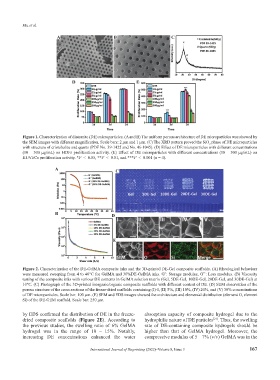
           Figure 1. Characterization of diatomite (DE) microparticles. (A and B) The uniform porous architecture of DE microparticles was showed by
           the SEM images with different magnification. Scale bars: 2 μm and 1 μm. (C) The XRD pattern proved the SiO  phase of DE microparticles
                                                                                          2
           with structure of cristobalite and quartz (PDF No. 39-1425 and No. 46-1045). (D) Effect of DE microparticles with different concentrations
           (10 – 500 μg/mL) on HDFs proliferation activity. (E) Effect of DE microparticles with different concentrations (10 – 500 μg/mL) on
           HUVECs proliferation activity. *P  <  0.05, **P  <  0.01, and ***P  <  0.001 (n = 4).

                        A                         C


                        B                       D


                                                 E


           Figure 2. Characterization of the DE-GelMA composite inks and the 3D-printed DE-Gel composite scaffolds. (A) Rheological behaviors
           were measured sweeping from 4 to 40°C for GelMA and 30%DE-GelMA inks. G’: Storage modulus, G’’: Loss modulus. (B) Viscosity
           testing of the composite inks with various DE contents in GelMA solution matrix (Gel, 5DE-Gel, 10DE-Gel, 20DE-Gel, and 30DE-Gel) at
           10°C. (C) Photograph of the 3D-printed inorganic/organic composite scaffolds with different content of DE. (D) SEM observation of the
           porous structure of the cross sections of the freeze-dried scaffolds containing (I) 0, (II) 5%, (III) 10%, (IV) 20%, and (V) 30% concentrations
           of DE microparticles. Scale bar: 100 μm. (E) SEM and EDS images showed the architecture and elemental distribution (element O, element
           Si) of the DE-GEM scaffold. Scale bar: 250 μm.

           by EDS confirmed the distribution of DE in the freeze-  absorption  capacity  of  composite  hydrogel  due  to  the
           dried  composite  scaffolds  (Figure  2E).  According  to   hydrophilic nature of DE particles [21] . Thus, the swelling
           the previous studies, the swelling ratio of 6% GelMA   rate  of  DE-containing  composite  hydrogels  should  be
           hydrogel  was  in  the  range  of  10  –  15%.  Notably,   higher  than  that  of  GelMA  hydrogel.  Moreover,  the
           increasing  DE  concentrations  enhanced  the  water   compressive modulus of 5 – 7% (v/v) GelMA was in the


                                       International Journal of Bioprinting (2022)–Volume 8, Issue 3       167

