


Page 138 - IJB-8-4
P. 138
3D Arenas for C. elegans Behavior
           in  z dimension (plane  perpendicular  to the  assay plate   made  of  2%  agar-based  NGM  hydrogel.  The  resulting
           surface) is essentially  limited to varying depth of the   arenas are nematode-friendly, minimizing the stress that
           arenas. Vertical elements, suspended features, multilevel   could have been induced when the animals are transferred
           structures, and other similar architectures are not allowed   from the culture plate into the arenas.
           using molds.                                            To demonstrate the suitability of the Parnon-printed
               To meet the need for alternative fabrication processes,   parts, we used them to assess C. elegans physical barrier
           we explored two methods. The first one includes the use of   crossing ability, in the context of aging (young, middle-
           polyvinyl alcohol (PVA), a water-soluble synthetic polymer,   aged  adults),  feeding  history  (fully  fed  [FF],  starved
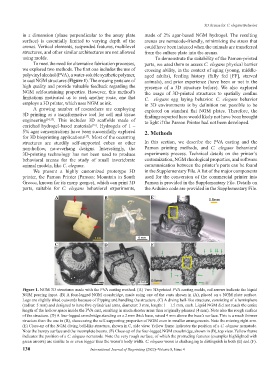
           to cast NGM structures (Figure 1). The ensuing parts are of   animals), and prior experience (have been or not in the
           high quality and provide valuable feedback regarding the   presence  of  a  3D  structure  before).  We  also  explored
           NGM  self-sustaining  properties.  However,  this  method’s   the  usage  of  3D-printed  structures  to  spatially  confine
           limitations  motivated  us  to  seek  another  route,  one  that   C.    elegans  egg  laying  behavior.  C. elegans behavior
           employs a 3D printer, which uses NGM as ink.        in 3D environments is by definition not possible to be
               A growing number of researchers  are employing   explored  on  standard  flat  NGM  plates.  Therefore,  the
           3D printing as a transformative tool for cell and tissue   findings reported here would likely not have been brought
           engineering [14,15] .  This  includes  3D  scaffolds  made  of   to light if the Parnon Printer had not been developed.
           enriched hydrogel-based materials . Hydrogels of 1 –
                                        [16]
           5% agar concentrations have been successfully explored   2. Methods
           for 3D bioprinting applications . Most of the occurring
                                     [17]
           structures are sturdily self-supported cubes or other   In this section,  we describe  the  PVA casting  and the
           non-hollow,  no-overhang  designs.  Interestingly,  the   Parnon printing  methods, and  C. elegans  behavioral
           3D-printing technology  has not been used to produce   experiments  process.  Technical  details  on  the  printer’s
           behavioral  arenas for the study of small  invertebrate   customization, NGM rheological properties, and software
           animal models, like C. elegans.                     communication between the printer’s parts can be found
               We  present  a  highly  customized  prototype  3D   in the Supplementary File. A list of the major components
           printer, the Parnon Printer (Parnon: Mountain in South   used for the conversion of the commercial  printer into
           Greece, known for its many gorges), which can print 3D   Parnon is provided in the Supplementary File. Details on
           parts, suitable for  C. elegans  behavioral  experiments,   the Arduino code are provided in the Supplementary File.

                        A                    B                   E


                        C                    D                   F


           Figure 1. NGM 3D structures made with the PVA casting method. (A) Two 3D-printed PVA casting molds, red arrows indicate the liquid
           NGM pouring input. (B) A four-legged NGM crossbridge, made using one of the casts shown in (A), placed on a NGM plate surface.
           Legs are slightly tilted outwards because of flipping and handling the structure. (C) A diving bell-like structure, consisting of a hemisphere
           (radius: 5 mm) and designed to have five cylindrical arms, diameter: 3 mm, length: 1 – 1.5 mm, each. Liquid NGM did not reach the entire
           length of the hollow space inside the PVA cast, resulting in much shorter arms than originally planned (4 mm). Note also the rough surface
           of the structure. (D) A four-legged crossbridge standing on a 2 mm thick base, raised 4 mm above the base’s surface. This is a much thinner
           structure than the one in (B), showcasing the self-supporting properties of NGM even in smaller arrangements. Note the missing right arm.
           (E) Close-up of the NGM diving bell-like structure, shown in C, side view. Yellow frame indicates the position of a C. elegans nematode.
           Note the bumpy surface and the incomplete beams. (F) Close-up of the four-legged NGM crossbridge, shown in (B), top view. Yellow frame
           indicates the position of a C. elegans nematode. Note the very rough surface, of which the protruding features (examples highlighted with
           green arrows) are similar to or even bigger than the worm’s body width. C. elegans worm is challenging to distinguish in both (E) and (F).
           130                         International Journal of Bioprinting (2022)–Volume 8, Issue 4

