


Page 163 - IJB-8-4
P. 163
Yang, et al.
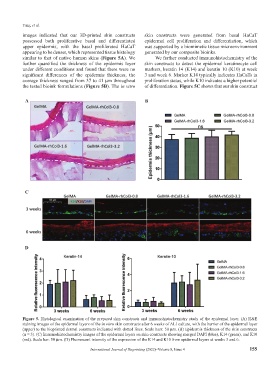
           images indicated  that our 3D-printed skin constructs   skin  constructs  were  generated  from  basal  HaCaT
           possessed  both  proliferative  basal  and  differentiated   epidermal  cell  proliferation  and  differentiation,  which
           upper epidermis,  with the basal proliferated  HaCaT   was supported by a biomimetic tissue microenvironment
           appearing to be denser, which represented tissue histology   generated by our composite bioinks.
           similar to that of native human skins (Figure 5A). We   We further conducted immunohistochemistry of the
           further  quantified  the  thickness  of  the  epidermis  layer   skin constructs to detect the epidermal keratinocyte cell
           under different conditions and found that there were no   markers, keratin 14 (K14) and keratin 10 (K10) at week
           significant  differences  of  the  epidermis  thickness,  the   3 and week 6. Marker K14 typically indicates HaCaTs in
           average thickness ranged from 37 to 41 μm throughout   proliferation status, while K10 indicates a higher potential
           the tested bioink formulations (Figure 5B). The in vitro   of differentiation. Figure 5C shows that our skin construct


            A                                                  B


            C


            D


           Figure 5. Histological examination of the prepared skin constructs and immunohistochemistry study of the epidermal layer. (A) H&E
           staining images of the epidermal layers of the in vitro skin constructs after 6 weeks of ALI culture, with the barrier of the epidermal layer
           (upper) to the bioprinted dermal constructs indicated with dotted lines. Scale bars: 50 μm. (B) Epidermis thickness of the skin constructs
           (n = 3). (C) Immunohistochemistry images of the epidermal layers on skin constructs showing merged DAPI (blue), K14 (green), and K10
           (red). Scale bar: 50 μm. (D) Fluorescent intensity of the expression of the K14 and K10 from epidermal layers at weeks 3 and 6.

                                       International Journal of Bioprinting (2022)–Volume 8, Issue 4       155

