


Page 164 - IJB-8-4
P. 164
Recombinant Human Collagen for 3D Bioprinting of Skin Equivalent
           had functional basal HaCaTs expressing proliferative   3.5. In vivo evaluation of bioinks
           marker K14 at week 3, while the differentiation marker K10
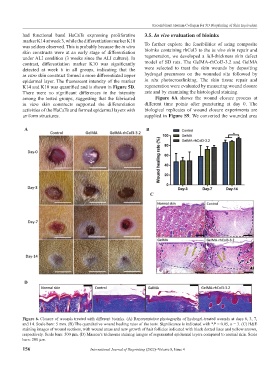
           was seldom observed. This is probably because the in vitro   To further explore the feasibilities of using composite
           skin constructs were at an early stage of differentiation   bioinks containing rhCol3 to the in vivo skin repair and
           under ALI condition (3 weeks since the ALI culture). In   regeneration, we developed a full-thickness skin defect
           contrast,  differentiation  marker  K10  was  significantly   model of SD rats. The GelMA-rhCol3-3.2 and GelMA
           detected at week 6 in all groups, indicating that the   were selected  to treat  the skin wounds by depositing
           in vitro skin construct formed a more differentiated upper   hydrogel precursors on the wounded site followed by
           epidermal layer. The fluorescent intensity of the marker   in  situ photocrosslinking.  The  skin tissue  repair  and
           K14 and K10 was quantified and is shown in Figure 5D.   regeneration were evaluated by measuring wound closure
           There  were  no  significant  differences  in  the  intensity   rate and by examining the histological staining.
           among the  tested  groups, suggesting that the  fabricated   Figure  6A shows  the wound closure process at
           in  vitro  skin  constructs  supported  the  differentiation   different  time  points  after  puncturing  at  day  0.  The
           activities of the HaCaTs and formed epidermal layers with   biological  replicates  of wound  closure  experiments  are
           uniform structures.                                 supplied in Figure S9. We converted the wounded area

           A                                                   B


                                                                 C


           D


           Figure 6. Closure of wounds treated with different bioinks. (A) Representative photographs of hydrogel-treated wounds at days 0, 3, 7,
           and 14. Scale bars: 5 mm. (B) The quantitative wound healing rates of the tests. Significance is indicated with *P < 0.05, n = 3. (C) H&E
           staining images of wound sections, with wound areas and new growth of hair follicles indicated with black dotted lines and yellow arrows,
           respectively. Scale bars: 500 μm. (D) Masson’s trichrome staining images of regenerated epidermal layers compared to normal skin. Scale
           bars: 200 μm.

           156                         International Journal of Bioprinting (2022)–Volume 8, Issue 4

