


Page 308 - IJB-8-4
P. 308
Vessel-on-a-Chip for Antiangiogenic Drug Screening


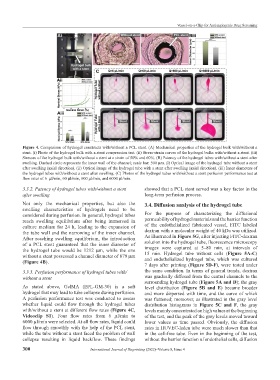
           Figure 4. Comparison of hydrogel constructs with/without a PCL stent. (A) Mechanical properties of the hydrogel bulk with/without a
           stent. (i) Photo of the hydrogel bulk with a stent compression test. (ii) Stress-strain curves of the hydrogel bulks with/without a stent. (iii)
           Stresses of the hydrogel bulk with/without a stent at a strain of 50% and 60%. (B) Patency of the hydrogel tubes with/without a stent after
           swelling. Dashed circle represents the inner wall of the channel; scale bar: 500 μm. (i) Optical image of the hydrogel tube without a stent
           after swelling (axial direction). (ii) Optical image of the hydrogel tube with a stent after swelling (axial direction). (iii) Inner diameters of
           the hydrogel tubes with/without a stent after swelling. (C) Photos of the hydrogel tubes with/without a stent perfusion performance test at
           flow rates of 6  μl/min, 60 μl/min, 600 μl/min, and 6000 μl/min.
           3.3.2. Patency of hydrogel tubes with/without a stent   showed that a PCL stent served was a key factor in the
           after swelling                                      long-term perfusion process.
           Not  only  the  mechanical  properties,  but  also  the   3.4. Diffusion analysis of the hydrogel tube
           swelling characteristics of hydrogels need to be
           considered during perfusion. In general, hydrogel tubes   For the purpose of characterizing  the diffusional
           reach swelling equilibrium after being immersed in   permeability of hydrogel materials and the barrier function
           culture medium for 24 h, leading to the expansion of   of the endothelialized  fabricated vessel, FITC labeled
           the tube wall and the narrowing of the inner channel.   dextran with a molecular weight of 40 kDa was utilized.
           After reaching swelling equilibrium, the introduction   As illustrated in Figure 5G, after injecting FITC-dextran
           of a PCL stent guaranteed that the inner diameter of   solution into the hydrogel tube, fluorescence microscopy
           the hydrogel tube would be 1212  μm, while the one   images  were  captured  at  5–80  min,  at  intervals  of
           without a stent possessed a channel diameter of 879 μm   15  min. Hydrogel  tube  without cells  (Figure  5A-C)
                                                               and endothelialized  hydrogel tube, which was cultured
           (Figure 4B).
                                                               7 days after printing (Figure 5D-F), were tested under
           3.3.3. Perfusion performance of hydrogel tubes with/   the same condition. In terms of general trends, dextran
           without a stent                                     was gradually diffused from the central channels to the
                                                               surrounding hydrogel tube (Figure 5A and D); the gray
           As stated above, GelMA (EFL-GM-30) is a soft        level  distribution  (Figure  5B and E) became  broader
           hydrogel that may lead to tube collapse during perfusion.   and more dispersed with time, and the curve of which
           A  perfusion performance test was conducted to assess   was flattened; moreover, as illustrated in the gray level
           whether  liquid  could  flow  through  the  hydrogel  tubes   distribution  histograms  in  Figure  5C  and F, the  gray
           with/without a stent at different flow rates (Figure 4C,   levels mainly concentrated on high values at the beginning
           Videoclip S1).  Four  flow  rates  from  6  μl/min to   of the test, and the peak of the gray levels moved toward
           6000 μl/min were selected. At all flow rates, liquid could   lower values  as time  passed. Obviously, the  diffusion
           flow through smoothly with the help of the PCL stent,   rates in HUVEC-laden tube were much slower than that
           while the tube without a stent faced the problem of wall   in the cell-free tube. Even in the beginning of the test,
           collapse  resulting  in  liquid  backflow.  These  findings   without the barrier function of endothelial cells, diffusion

           300                         International Journal of Bioprinting (2022)–Volume 8, Issue 4

