


Page 323 - IJB-8-4
P. 323
Bonatti, et al.
                        A


                        B                                            C


                        D                                            E


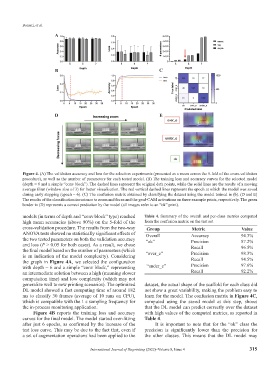
           Figure 4. (A) The validation accuracy and loss for the selection experiments (presented as a mean across the 5-fold of the cross-validation
           procedure), as well as the number of parameters for each tested model. (B) The training loss and accuracy curves for the selected model
           (depth = 6 and a simple “conv block”). The dashed lines represent the original data points, while the solid lines are the results of a moving
           average filter (window size of 3) for better visualization. The red vertical dashed lines represent the epoch at which the model was saved
           during early stopping (epoch = 6). (C) The confusion matrix obtained by classifying the dataset using the model trained in (b). (D and E)
           The results of the classification invariance to zoom and focus and the grad-CAM activations on three example prints, respectively. The green
           border in (D) represents a correct prediction by the model (all images refer to an “ok” print).
           models (in terms of depth and “conv block” type) reached   Table 4. Summary of the overall and per-class metrics computed
           high mean accuracies (above 90%) on the 5-fold of the   from the confusion matrix on the test set
           cross-validation procedure. The results from the two-way   Group        Metric               Value
           ANOVA tests showed no statistically significant effects of   Overall   Accuracy              94.3%
           the two tested parameters on both the validation accuracy   “ok”       Precision             87.2%
           and loss (P > 0.05 for both cases). As a result, we chose              Recall                96.5%
           the final model based on the number of parameters (which   “over_e”    Precision             98.3%
           is an indication of the model complexity). Considering                 Recall                94.5%
           the  graph in  Figure  4A, we selected  the  configuration
           with depth = 6 and a simple “conv block,” representing   “under_e”     Precision             97.6%
           an intermediate solution between a high (meaning slower                Recall                92.2%
           computation time) and low complexity (which may not
           generalize well to new printing scenarios). The optimized   dataset, the actual shape of the scaffold for each class did
           DL model showed a fast computing time of around 182   not show a great variability, making the problem easy to
           ms to classify 30 frames (average of 10 runs on CPU),   learn for the model. The confusion matrix in Figure 4C,
           which is compatible with the 1 s sampling frequency for   computed  using the saved model at this step, shows
           the in-process monitoring application.              that the DL model can predict correctly over the dataset
               Figure  4B reports the training  loss and accuracy   with high values of the computed metrics, as reported in
           curves for the final model. The model started over-fitting   Table 4.
           after just 6 epochs, as confirmed by the increase of the   It is important to note that for the “ok” class the
           test loss curve. This may be due to the fact that, even if   precision  is  significantly  lower  than  the  precision  for
           a set of augmentation operations had been applied to the   the  other  classes.  This  means  that  the  DL  model  may


                                       International Journal of Bioprinting (2022)–Volume 8, Issue 4       315

