


Page 291 - IJB-9-2
P. 291
International Journal of Bioprinting                                    Methodology of hydrogel printability


               This  methodology enables  the  classification  of new
            materials according to different characterization tests, such
            as sessile drop method, filament collapse test, quantitative
            evaluation of the state of gelation, and printing grid test.
            To this end, we developed the techniques mentioned and
            created a platform adapted to the Bio X bioprinter for
            filament collapse test. In the process, we assigned numerical
            values to help determine hydrogels with the most suitable
            characteristics for bioprinting.

            3. Methodology
            This methodology is designed to characterize hydrogels
            that are going to be used to bioprint cells inside them, i.e.,
            those that can be printed at temperatures close to 37°C.
            First of all, the pressure and temperature parameters were
            adjusted by means of the droplet test of the extrusion-
            based bioprinter so that they were always within the
            ranges that allow cell viability. Therefore, as a reference, the
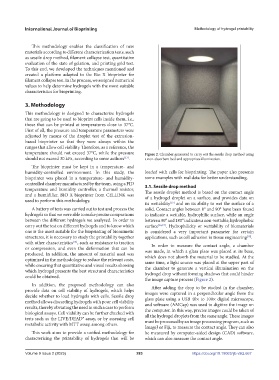
            temperature should not exceed 37°C, while the pressure   Figure 2. Chamber generated to carry out the sessile drop method using
            should not exceed 30 kPa, according to some authors .  a non-absorbent bed and appropriate illumination.
                                                      [13]
               The bioprinter must be kept in a temperature- and
            humidity-controlled environment. In this study, the   loaded with cells for bioprinting. The paper also presents
            bioprinter was placed in a temperature- and humidity-  some examples with real data for better understanding.
            controlled chamber manufactured by the team, using a PID   3.1. Sessile drop method
            temperature and humidity controller, a thermal resistor,   The sessile droplet method is based on the contact angle
            and a humidifier. BIO X bioprinter from CELLINK was   of a hydrogel droplet on a surface, and provides data on
            used to perform this methodology.
                                                               its wettability  and on its ability to wet the surface of a
                                                                          [15]
               A battery of tests was carried out to test and process the   solid. Contact angles between 0° and 90° have been found
            hydrogels so that we were able to make precise comparisons   to indicate a wettable, hydrophilic surface, while an angle
            between the different hydrogels we analyzed. In order to   between 90° and 180° indicates a non-wettable, hydrophobic
            carry out the test on different hydrogels and to know which   surface [16,17] . Hydrophilicity or wettability of biomaterials
            one is the most suitable for the bioprinting of biomimetic   is considered a very important parameter for certain
            structures, it is necessary to study the printability together   applications, such as cell adhesion in tissue engineering .
                                                                                                          [18]
            with other characteristics , such as resistance to traction   In order to measure the contact angle, a chamber
                                [14]
            or compression, and even the deformation that can be   was made, in which a glass plate was placed at its base,
            produced. In addition, the amount of material used was   which does not absorb the material to be studied. At the
            optimized in the methodology to reduce the relevant costs,   same time, a light source was placed at the upper part of
            while ensuring that quantitative and visual results showing   the  chamber  to  generate  a  vertical illumination  on  the
            which hydrogel presents the best structural characteristics   hydrogel drop without forming shadows that could hinder
            could be obtained.
                                                               the image capture process (Figure 2).
               In addition, the proposed methodology can also
                                                                  After adding the drop to be studied in the chamber,
            provide data on cell viability of hydrogels, which helps   images were captured in a perpendicular angle from the
            decide whether to load hydrogels with cells. Sessile drop   glass plate using a USB 40× to 100× digital microscope,
            method allows discarding hydrogels with poor cell viability   and software (AMCap) was used to digitize the image on
            results, thereby obviating the need in such a case to perform   the computer. In this way, precise images could be taken of
            biological assays. Cell viability can be further checked with   all the hydrogel droplets from the same angle. These images
            tests such as the LIVE/DEAD® assay, or by assessing cell   must be processed by an image processing program, such as
            metabolic activity with MTT assay, among others.
                                                               ImageJ or Fiji, to measure the contact angle. They can also
               This work aims to provide a unified methodology for   be measured by computer-aided design (CAD) software,
            characterizing the printability of hydrogels that will be   which can also measure the contact angle.


            Volume 9 Issue 2 (2023)                        283                     https://doi.org/10.18063/ijb.v9i2.667

