


Page 343 - IJB-9-2
P. 343
International Journal of Bioprinting                            Characterization of BITC antibacterial hydrogel


                         A                                   B


                         C                                   D


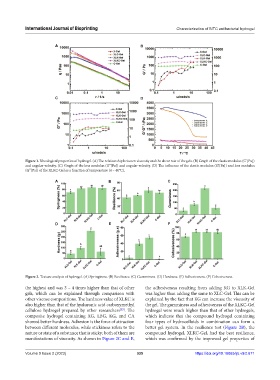
            Figure 1. Rheological properties of hydrogel. (A) The relationship between viscosity and the shear rate of the gels. (B) Graph of the elastic modulus (G’[Pa])
            and angular velocity. (C) Graph of the loss modulus (G’’[Pa]) and angular velocity. (D) The influence of the elastic modulus (G’[Pa]) and loss modulus
            (G’’[Pa]) of the XLKC-Gel as a function of temperature (4 – 40°C).

                         A                     B                        C


                         D                     E                        F


            Figure 2. Texture analysis of hydrogel. (A) Springiness. (B) Resilience. (C) Gumminess. (D) Hardness. (E) Adhesiveness. (F) Cohesiveness.

            the highest and was 3 – 4 times higher than that of other   the adhesiveness resulting from adding KG to XLK-Gel
            gels,  which  can  be  explained  through  comparison  with   was higher than adding the same to XLC-Gel. This can be
            other viscose compositions. The hardness value of XLKC is   explained by the fact that KG can increase the viscosity of
            also higher than that of the hyaluronic acid carboxymethyl   the gel. The gumminess and adhesiveness of the XLKC-Gel
            cellulose hydrogel prepared by other researchers . The   hydrogel were much higher than that of other hydrogels,
                                                    [33]
            composite hydrogel containing XG, LBG, KG, and CA   which indicate that the compound hydrogel containing
            showed better hardness. Adhesion is the force of attraction   four types of hydrocolloids in combination can form a
            between different molecules, while stickiness refers to the   better gel system. In the resilience test (Figure  2B), the
            nature or state of a substance that is sticky; both of them are   compound hydrogel, XLKC-Gel, had the best resilience,
            manifestations of viscosity. As shown in Figure 2C and E,   which was confirmed by the improved gel properties of


            Volume 9 Issue 2 (2023)                        335                      https://doi.org/10.18063/ijb.v9i2.671

