


Page 366 - IJB-9-2
P. 366
International Journal of Bioprinting               Laser bioprinting of hiPSC-derived neural stem cells and neurons


                                                                  The development of the network after printing under
                                                               neuronal differentiation conditions is shown in Figure 8A
                                                               and 8B. Panels depict the raster plots of activity for 1,000
                                                               individual neurons on top, and the averaged activity (termed
                                                               “global network activity”) at the bottom. Figure 8A shows
                                                               the development of printed neurons 27 (left), 39 (middle)
                                                               and 67 (right) days in differentiation medium after printing.
                                                               For comparison, Figure 8B shows the development for cells
                                                               that were neuronally pre-differentiated for 5 days, printed,
                                                               and then cultured in differentiation medium for additional
                                                               22 (left), 44 (middle), and 67 (right) days after printing.
                                                               We note that, for printed NSCs, no collective activity could
                                                               be observed at 27 days in the example shown. However,
                                                               the time of the first appearance of bursting events varied
                                                               among experimental realizations, and thus in other
                                                               experiments with NSCs of different passages we already
                                                               observed bursting events before day 20. Overall, the panels
                                                               reveal a gradual increase of activity, with clear bursts at
                                                               day 39 that become stronger at day 67 and later. Thus,
                                                               there is a clear evolution of burst over time. In the case of
                                                               pre-differentiated neurons, these collective activity events
                                                               could already be observed after 22 days (or 27 days of total
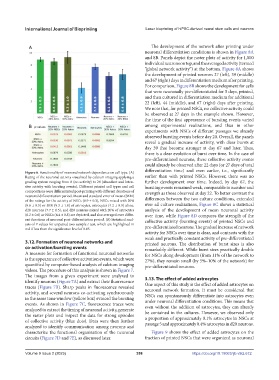
            Figure 6. Functionality of neuronal network dependence on cell type. (A)   differentiation time) and even earlier, i.e., significantly
            Rating of the neuronal activity visualized by calcium imaging applying a   earlier than with printed NSCs. However, there was no
            grading system ranging from 0 (no activity) to 24 (abundant and inten-  further  development  over  time.  Indeed,  by  day  67,  the
            sive activity with bursting events). Different printed cell types and cell   bursting events remained weak, comparable in number and
            compositions were differentiated post-printing with different durations of   strength as those observed at day 22. To better contrast the
            neuronal differentiation period. Mean and standard error of mean (SEM)
            of the ratings for the activity of NSCs (8.9 ± 0.3), NSCs mixed with 20%   differences between the two culture conditions, extended
            (8.6 ± 0.5) or 50% (9.3 ± 1.0) of astrocytes, astrocytes (4.2 ± 0.9) alone,   over all culture realizations, Figure 8C shows a statistical
            d20 neurons (7.7 ± 0.5), and d20 neurons mixed with 20% of astrocytes   analysis of the development of mean neuronal activity
            (6.2 ± 0.6) or NSCs (6.4 ± 0.8) are depicted, and also averaged over differ-  over time, while Figure 8D compares the strength of the
            ent durations of neuronal post-differentiation period. (B) Statistical anal-  collective activity (bursting events) of printed NSCs and
            ysis of P values for unpaired two-sample t-test, which are highlighted in
            red if less than the significance level of 0.05.   pre-differentiated neurons. The gradual increase of network
                                                               activity for NSCs over time is clear, and contrasts with the
                                                               weak and practically constant activity of pre-differentiated
            3.12. Formation of neuronal networks and           printed neurons. The distribution of burst sizes is also
            co-activation/bursting events                      remarkably different. While burst sizes practically double
            A measure for formation of functional neuronal networks   for NSCs along development (from 11% of the network to
            is the appearance of collective activation events, which were   27%), they remain small (by 5%–10% of the network) for
            quantified by computer-based analysis of calcium imaging   pre-differentiated neurons.
            videos. The procedure of this analysis is shown in Figure 7.
            The images from a given experiment were analyzed to
            identify neurons (Figure 7A) and extract their fluorescence   3.13. The effect of added astrocytes
            traces (Figure 7B). Sharp peaks in fluorescence revealed   One aspect of this study is the effect of added astrocytes on
            activity, and several neurons co-activating synchronously   neuronal network formation. It must be considered that
            in the same time window (yellow box) evinced the bursting   NSCs can spontaneously differentiate into astrocytes even
            events. As shown in Figure 7C, fluorescence traces were   under neuronal differentiation conditions. This means that
            analyzed to extract the timing of neuronal activity, generate   even without the addition of astrocytes, they can already
            the raster plots and inspect the data for strong episodes   be contained in the cultures. However, we observed only
            of collective activity (blue dots). Data were then further   a proportion of approximately 0.1% astrocytes in NSCs at
            analyzed to identify communication among neurons and   passage 5 and approximately 0.4% astrocytes in d20 neurons.
            characterize the functional organization of the neuronal   Figure 9 shows the effect of added astrocytes on the
            circuits (Figure 7D and 7E), as discussed later.   fraction of printed NSCs that were organized as neuronal


            Volume 9 Issue 2 (2023)                        358                     https://doi.org/10.18063/ijb.v9i2.672

