


Page 382 - IJB-9-2
P. 382
International Journal of Bioprinting  3D gel-printed β-TCP/TiO2 porous scaffolds for cancellous bone tissue engineering


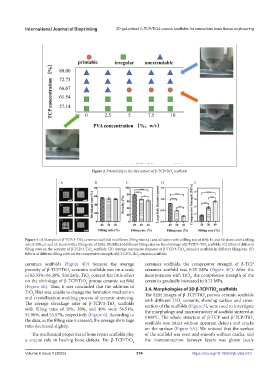
                                        Figure 2. Printability in the fabrication of β-TCP/TiO  scaffolds
                                                                           2


            Figure 3. (A) Samples of β-TCP/3-TiO  ceramics scaffolds in different filling rates (a1 and a2: stents with a filling rate of 40%; b1 and b2: stents with a filling
                                    2
            rate of 30%; c1 and c2: stents with a filling rate of 20%). (B) Effect of different filling rates on the shrinkage of β-TCP/3-TiO  scaffolds. (C) Effect of different
                                                                                         2
            filling rates on the porosity of β-TCP/3-TiO  scaffolds. (D) Average macropore diameter of β-TCP/3-TiO  ceramics scaffolds in different filling rate. (E)
                                        2
                                                                               2
            Effects of different filling rates on the compressive strength of β-TCP/3-TiO ceramics scaffolds.
                                                            2
            ceramics  scaffolds  (Figure  4D)  because  the  average   ceramics  scaffolds,  the  compressive  strength of  β-TCP
            porosity of β-TCP/TiO  ceramics scaffolds was on a scale   ceramics scaffold was 0.35 MPa (Figure 4C). After the
                              2
            of 65.55%–66.39%. Similarly, TiO  content has little effect   incorporation with TiO , the compressive strength of the
                                       2
                                                                                  2
            on the shrinkage of β-TCP/TiO  porous ceramic scaffold   ceramics gradually increased to 0.72 MPa.
                                      2
            (Figure 4E). Thus, it was concluded that the addition of   3.4. Morphologies of 3D β-TCP/TiO  scaffolds
            TiO filler was unable to change the formation mechanism   The SEM images of β-TCP/TiO  porous ceramic scaffolds
                                                                                             2
               2
            and crystallization-molding process of ceramic sintering.   with different TiO  contents, showing surface and cross-
                                                                                        2
            The average shrinkage rates of β-TCP/3-TiO  scaffolds   section of the scaffolds (Figure 5), were used to investigate
                                                                              2
                                                  2
            with  filling  rates  of  20%,  30%,  and  40%  were  56.51%,   the morphology and microstructure of scaffold sintered at
            54.96%, and 53.57%, respectively (Figure 6). According to   1100°C. The whole structure of β-TCP and β-TCP/TiO
            the data, as the filling rate increased, the average shrinkage   scaffolds was intact without apparent defects and cracks
                                                                                                             2
            rates decreased slightly.
                                                               on the surface (Figure 5A). We noticed that the surface
               The mechanical properties of bone repair scaffolds play   of the scaffold was even and smooth without cracks, and
            a crucial  role in  healing  bone  defects.  For β-TCP/TiO    the interconnection between layers was glossy (scale
                                                          2
            Volume 9 Issue 2 (2023)                        374                     https://doi.org/10.18063/ijb.v9i2.673

