


Page 385 - IJB-9-2
P. 385
International Journal of Bioprinting   3D gel-printed β-TCP/TiO2 porous scaffolds for cancellous bone tissue engineering


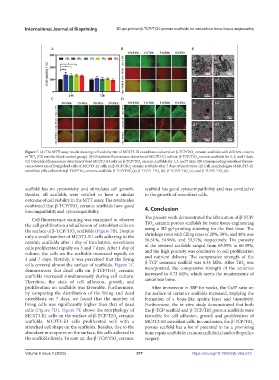
            Figure 7. (A) The MTT assay results showing cell viability rate of MC3T3-E1 osteoblasts cultured on β-TCP/TiO  ceramic scaffolds with different content
                                                                                   2
            of TiO  (CK was the blank control group). (B) Osteoblast fluorescence detection of MC3T3-E1 cells on β-TCP/TiO  ceramic scaffolds for 1, 3, and 7 days.
                                                                                     2
                2
            (C) Osteoblast fluorescence detection of dead MC3T3-E1 cells on β-TCP/TiO  ceramic scaffolds for 1, 3, and 7 days. (D) Corresponding osteoblast fluores-
                                                             2
            cence detection of living/dead cells of MC3T3-E1 cells on β-TCP/TiO  ceramic scaffolds after 7 days of incubation. (E) Cell morphologies of MC3T3-E1
                                                         2
            osteoblast cells cultured on β-TCP/TiO  ceramic scaffolds: β-TCP/TiO  (a), β-TCP/1-TiO  (b), β-TCP/3-TiO  (c), and β-TCP/5-TiO (d).
                                     2                   2           2           2              2
            scaffold  has  no  cytotoxicity  and  stimulates  cell  growth.   scaffold has good cytocompatibility and was conducive
            Besides, all scaffolds were verified to have a similar   to the growth of osteoblast cells.
            outcome of cell viability in the MTT assay. The results also
            confirmed that β-TCP/TiO  ceramic scaffolds have good   4. Conclusion
                                  2
            biocompatibility and cytocompatibility.
               Cell fluorescence staining was examined to observe   The present work demonstrated the fabrication of β-TCP/
            the cell proliferation and adhesion of osteoblast cells on   TiO  ceramic porous scaffolds for bone tissue engineering
                                                                  2
            the surface of β-TCP/TiO  scaffolds (Figure 7B). Despite   using a 3D gel-printing sintering for the first time. The
                                 2
            only a small number of MC3T3-E1 cells adhering to the   shrinkage ratio with filling rates of 20%, 30%, and 40% was
            ceramic scaffolds after 1 day of incubation, osteoblasts   56.51%, 54.96%, and 53.57%, respectively. The porosity
            cells proliferated rapidly on 3 and 7 days. After 1 day of   of the sintered scaffolds ranged from 65.55% to 66.39%,
            culture, the cells on the scaffolds increased rapidly on   and the high porosity was conducive to cell proliferation
            3 and 7 days. Notably, it was perceived that the living   and nutrient delivery. The compressive strength of the
            cells covered almost the surface of scaffolds. Figure 7C   β-TCP ceramics scaffold was 0.35 MPa. After TiO  was
                                                                                                         2
            demonstrates that dead cells on β-TCP/TiO  ceramic   incorporated, the compressive strength of  the  ceramics
                                                  2
            scaffolds increased simultaneously during cell culture.   increased to 0.72 MPa, which meets the requirements of
            Therefore, the state of cell adhesion, growth, and   cancellous bone.
            proliferation on scaffolds was favorable. Furthermore,   After immersion in SBF for weeks, the Ca/P ratio on
            by  comparing  the  distribution  of  the  living and  dead   the surface of ceramics scaffolds increased, implying the
            osteoblasts on 7 days, we found that the number of   formation of a bone-like apatite layer and bioactivity.
            living cells was significantly higher than that of dead   Furthermore, the  in vitro study demonstrated that both
            cells (Figure 7D). Figure 7E shows the morphology of   the β-TCP scaffold and β-TCP/TiO porous scaffolds were
                                                                                           2
            MC3T3-E1 cells on the surface of β-TCP/TiO  ceramic   favorable for cell adhesion, growth and proliferation of
                                                  2
            scaffolds. MC3T3-E1 cells proliferated well with a   MC3T3-E1 osteoblast cells. In conclusion, the β-TCP/TiO 2
            stretched cell shape on the scaffolds. Besides, due to the   porous scaffold has a lot of potential to be a promising
            abundant micropores on the surface, the cells adhered to   bone repair scaffold in craniomaxillofacial and orthopedics
            the scaffolds firmly. To sum up, the β-TCP/TiO  ceramic   surgery.
                                                   2

            Volume 9 Issue 2 (2023)                        377                     https://doi.org/10.18063/ijb.v9i2.673

