


Page 384 - IJB-9-2
P. 384
International Journal of Bioprinting  3D gel-printed β-TCP/TiO2 porous scaffolds for cancellous bone tissue engineering


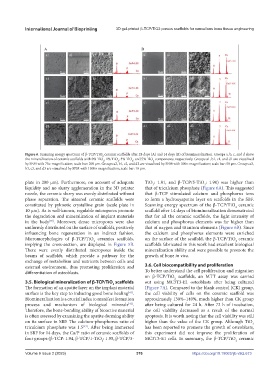
            Figure 6. Scanning energy spectrum of β-TCP/TiO  ceramic scaffolds after 28 days (A) and 14 days (B) of biomineralization. Groups a, b, c, and d show
                                             2
            the mineralization of ceramic scaffolds with 0% TiO , 1% TiO , 3% TiO , and 5% TiO  components, respectively. Groups a1, b1, c1, and d1 are visualized
                                                                  2
                                                         2
                                                   2
                                             2
            by SEM with 75× magnification; scale bar: 200 μm. Groups a2, b1, c2, and d2 are visualized by SEM with 300× magnification; scale bar: 50 μm. Groups a3,
            b3, c3, and d3 are visualized by SEM with 1500× magnification; scale bar: 10 μm.
            plate in 200 μm). Furthermore, on account of adequate   TiO : 1.81, and β-TCP/5-TiO : 1.90) was higher than
                                                                  2
                                                                                        2
            liquidity and no slurry agglomeration in the 3D printer   that of tricalcium phosphate (Figure 6A). This suggested
            nozzle, the ceramic slurry was evenly distributed without   that β-TCP stimulated calcium and phosphorus ions
            phase separation. The sintered ceramic scaffolds were   to form a hydroxyapatite layer on scaffolds in the SBF.
            constituted by pyknotic crystalline grain (scale plate in   Scanning energy spectrum of the β-TCP/TiO  ceramic
                                                                                                     2
            10 µm). As is well-known, regulable micropores promote   scaffold after 14 days of biomineralization demonstrated
            the degradation and mineralization of implant materials   that for all the ceramic scaffolds, the light intensity of
            in the body . Moreover, dense micropores were also   calcium and phosphorus elements was far higher than
                      [39]
            uniformly distributed on the surface of scaffolds, positively   that of oxygen and titanium elements (Figure 6B). Since
            influencing bone regeneration in an indirect fashion.   the calcium and phosphorus elements were enriched
            Micromorphologies of β-TCP/TiO  ceramics scaffolds,   on the surface of the scaffold, the β-TCP/TiO  ceramic
                                         2
                                                                                                      2
            implying the cross-section, are displayed in  Figure 5B.   scaffolds fabricated in this work had excellent biological
            There were evenly distributed micropores inside the   mineralization ability and were possible to promote the
            beams of scaffolds, which provide a pathway for the   growth of bone in vivo.
            exchange of metabolism and nutrients between cells and
            external environment, thus promoting proliferation and   3.6. Cell biocompatibility and proliferation
            differentiation of osteoblasts.                    To better understand the cell proliferation and migration
                                                               on β-TCP/TiO  scaffolds, an MTT assay was carried
                                                                           2
            3.5. Biological mineralization of β-TCP/TiO  scaffolds  out using MC3T3-E1 osteoblasts after being cultured
                                                 2
            The formation of an apatite layer on the implant material   (Figure 7A). Compared to the blank control (CK) group,
            surface is the key step to inducing good bone healing [41] .   the cell viability of cells on the ceramic scaffold was
            Biomineralization is a crucial index to manifest formation   approximately 130%–140%, much higher than CK group
            process and mechanism of biological minerals [42] .   after being cultured for 24 h. After 72 h of incubation,
            Therefore, the bone-bonding ability of bioactive material   the  cell  viability  decreased  as  a  result  of  the  normal
            is often assessed by examining the apatite-forming ability   apoptosis. It is worth noting that the cell viability was still
            on its surface in SBF. The calcium-phosphorus ratio of   higher than the value of the CK group. Although TiO 2
            tricalcium phosphate was 1.5 [43] . After being immersed   has been reported to promote the growth of osteoblasts,
            in SBF for 14 days, the Ca/P ratio of ceramic scaffolds of   this experiment did not improve the proliferation of
            four groups (β-TCP: 1.94, β-TCP/1-TiO : 1.95, β-TCP/3-  MC3T3-E1 cells. In summary, the β-TCP/TiO  ceramic
                                                                                                      2
                                            2
            Volume 9 Issue 2 (2023)                        376                     https://doi.org/10.18063/ijb.v9i2.673

