


Page 404 - IJB-9-4
P. 404
International Journal of Bioprinting                 Impingement shear stress during microvalve-based bioprinting


            maximum impingement shear stress was at H = 2.8 mm.   To validate the results of numerical simulation and
            Phares  et al.  also reported an analytical relation to   our hypothesis that the impingement shear stress has
                       [32]
            calculate the maximum wall shear stress in axisymmetric   a detrimental effect on cell survival during microvalve
            fully developed steady-state jet impingement as:   bioprinting, we conducted a simple experiment: We printed
                                                               cell suspension of alginate solution at constant upstream
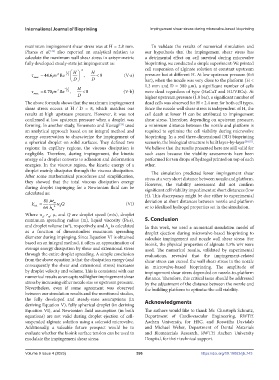
               max.   44 .6 v Re 1 2    H   2 ,  H   8  (V-a)  pressure but at different H. At low upstream pressure (0.6
                          2
                                 D    D                      bar), when the nozzle was very close to the platform (H <
                                                               1.2 mm and D = 300 µm), a significant number of cells
                                  H
                         2
               max.    . 070 v Re 1 2 ,   8      (V-b)    were dead regardless of type (HaCaT and HUVECs). At
                                  D                            higher upstream pressure (1.0 bar), a significant number of
            The above formula shows that the maximum impingement   dead cells was observed for H < 2.4 mm for both cell types.
            shear stress occurs at H ⁄ D = 8, which matches our   Since the nozzle wall shear stress is independent of H, the
            results at high upstream pressure. However, it was not   cell death at lower H can be attributed to impingement
            confirmed at low upstream pressure when a droplet was   shear stress. Therefore, depending on upstream pressure,
            forming. In another study, Yonemoto and Kunugi  used   a minimum distance between the nozzle and platform is
                                                    [33]
            an analytical approach based on an integral method and   required to optimize the cell viability during microvalve
            energy conservation to characterize the impingement of   bioprinting. In a real three-dimensional (3D) bioprinting
            a spherical droplet on solid surfaces. They defined two   scenario, the biological structure is built layer-by-layer [34,35] .
            regions: In capillary regions, the viscous dissipation is   We believe that the results presented here are still valid for
            negligible. Therefore, during impingement, the kinetic   such  cases  because  the  viability  assessments  have  been
            energy of a droplet converts to adhesion and deformation   performed for ten drops of hydrogel printed on top of each
            energies.  In  the  viscous  region,  the  kinetic  energy  of  a   other.
            droplet mainly dissipates through the viscous dissipation.   The simulation predicted lower impingement shear
            After some mathematical procedures and simplification,   stress at a very short distance between nozzle and platform.
            they showed that the total viscous dissipation energy   However, the viability assessment did not confirm
            during droplet impinging for a Newtonian fluid can be   significant cell viability impediment at short distances (low
            calculated as:                                     H). This discrepancy might be due either to experimental
                    81  r                                     deviation at short distances between nozzle and platform
               E vis.    m 2  uQ                      (VI)
                          d
                    64
                      h
                       m                                       or to idealized hydrogel properties set in the simulation.
            Where u , r , μ, and Q are droplet speed (m/s), droplet
                   d
                      m
            maximum spreading radius  (m),  liquid  viscosity (Pa·s),   5. Conclusion
            and droplet volume (m ), respectively, and h  is calculated   In this work, we used a numerical simulation model of
                              3
                                               m
            as a function of dimensionless maximum spreading   droplet ejection during microvalve-based bioprinting to
            diameter during impinging. Since Equation VI is obtained   calculate impingement and nozzle wall shear stress. For
            based on an integral method, it offers an approximation of   bioink, the physical properties of alginate 1.5% w/v were
            average energy dissipation by shear and extensional stress   used.  The numerical  results,  validated by experimental
            through the entire droplet spreading. A simple conclusion   evaluations, revealed that the impingement-related
            from the above equation is that the dissipation energy (and   shear stress can exceed the wall shear stress in the nozzle
            consequently the shear and extensional stress) increases   in microvalve-based bioprinting. The amplitude of
            by droplet velocity and volume. This is consistent with our   impingement shear stress depended on nozzle-to-platform
            numerical results as we captured higher impingement shear   distance. Therefore, this critical issue should be addressed
            stress by increasing either nozzle size or upstream pressure.   by the adjustment of the distance between the nozzle and
            Nevertheless, even if some agreement was observed   the building platform to optimize the cell viability.
            between our simulation results and the mentioned studies,
            the fully developed and steady-state assumptions (in   Acknowledgments
            deriving Equation V), fully spherical droplet (in deriving
            Equation VI), and Newtonian fluid assumption (in both   The authors would like to thank Mr. Christoph Schmitz,
            equations) are not valid during droplet ejection of cell-  Department of Cardiovascular Engineering, RWTH
            suspended alginate solution using a solenoid microvalve.   Aachen University, for HSC, and Roswitha Davtalab
            Additionally,  a  valuable  future  prospect  would  be  to   and Michael Weber, Department of Dental Materials
            evaluate whether the bioink surface tension can be used to   and Biomaterials Research, RWTH Aachen University
            modulate the impingement shear stress.             Hospital, for their technical support.


            Volume 9 Issue 4 (2023)                        396                         https://doi.org/10.18063/ijb.743

