


Page 459 - IJB-9-4
P. 459
International Journal of Bioprinting                   β-Ti21S auxetic FGPs produced by laser powder bed fusion


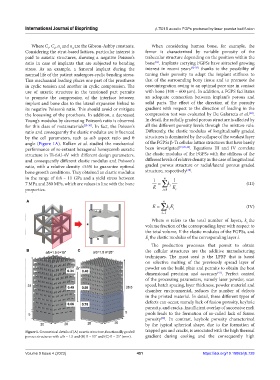
              Where C , C , n  and n  are the Gibson-Ashby constants.   When considering human bone, for example, the
                        2
                     1
                                2
                          1
            Considering the strut-based lattices, particular interest is   femur  is  characterized  by  variable  porosity  of  the
            paid to auxetic structures, showing a negative Poisson’s   trabecular structure depending on the position within the
                                                                   [31]
            ratio in case of implants that are subjected to bending   bone . Implants carrying FGPSs have attracted growing
            stress.  As  an example,  a  femoral  implant  during  the   interest  in  recent  years [32-37]   thanks  to  the  possibility  of
            normal life of the patient undergoes cyclic bending stress.   tuning their porosity to adapt the implant stiffness to
            This mechanical loading places one part of the prosthesis   that of the surrounding bony tissue and to promote the
            in cyclic tension and another in cyclic compression. The   osseointegration owing to an optimal pore size in contact
            use of auxetic structure in the tensioned part permits   with bone (100 – 600 µm). In addition, a FGPS facilitates
            to promote the compression of the interface between   an adequate connection between implant’s porous and
            implant and bone due to the lateral expansion linked to   solid parts. The effect of the direction of the porosity
            its negative Poisson’s ratio. This should avoid or mitigate   gradient with respect to the direction of loading in the
                                                                                                           [38]
            the loosening of the prosthesis. In addition, a decreased   compression test was evaluated by De Galarreta et al. .
            Young’s modulus by decreasing Poisson’s ratio is observed   In detail, the radially graded porous structure is affected by
            for this class of metamaterials [23-30] . In fact, the Poisson’s   all the different porosity levels through the mixture rule.
            ratio and consequently the elastic modulus are influenced   Differently, the elastic modulus of longitudinally graded
            by the cell parameters, such as  a/b aspect ratio and  θ   structures is dominated by the collapse of the weakest layer
            angle  (Figure  1A).  Kolken  et al.  studied  the  mechanical   of the FGPSs β-Ti cellular lattice structures that have barely
            performance of re-entrant hexagonal honeycomb auxetic   been investigated [19,39,40] . Equations III and IV correlate
            structure in Ti-6Al-4V with different design parameters,   the elastic modulus of the FGPSs with the stiffness of the
            and consequently different elastic modulus and Poisson’s   different levels of relative density in the case of longitudinal
            ratio, with a relative density <55% to guarantee optimal   graded porous structure or radial/lateral porous graded
                                                                                [38]
            bone growth conditions. They obtained an elastic modulus   structure, respectively .
            in the range of 0.8 – 11 GPa and a yield stress between   1  n  1
            7 MPa and 280 MPa, which are values in line with the bone   = ∑ k i                           (III)
            properties.                                           E   i= 1  E i

            A                                                         n
                                                                  E = ∑ k E i                             (IV)
                                                                         i
                                                                      i=1
                                                                 Where  n refers to the total number of layers,  k the
                                                                                                          i
                                                               volume fraction of the corresponding layer with respect to
                                                               the total volume, E the elastic modulus of the FGPSs, and
                                                               E the elastic modulus of the corresponding layer i.
                                                                i
                                                                 The production processes that permit to obtain
            B                     C                            the  cellular  structures are  the additive  manufacturing
                                                               techniques. The most used is the LPBF that is based
                                                               on selective melting of the previously spread layer of
                                                               powder on the build plate and permits to obtain the best
                                                               dimensional precision and accuracy . Perfect control
                                                                                             [41]
                                                               of the processing parameters, namely laser powder, scan
                                                               speed, hatch spacing, layer thickness, powder material and
                                                               chamber environmental, reduces the number of defects
                                                               in the printed material. In detail, three different types of
                                                               defects can occur, namely lack of fusion porosity, keyhole
                                                               porosity, and cracks. Insufficient overlap of successive melt
                                                               pools leads to the formation of so-called lack of fusion
                                                               porosity .  In  contrast,  keyhole  porosity  characterized
                                                                     [42]
                                                               by the typical spherical shape, due  to the formation of
            Figure 1. Geometrical details of (A) auxetic structure, functionally graded   trapped gas and cracks, is associated with the high thermal
            porous structures with a/b = 1.5 and (B) θ = 15° and (C) θ = 25° (mm).  gradient during cooling and the consequently high


            Volume 9 Issue 4 (2023)                        451                          https://doi.org/10.18063/ijb.728

