


Page 462 - IJB-9-4
P. 462
International Journal of Bioprinting                   β-Ti21S auxetic FGPs produced by laser powder bed fusion


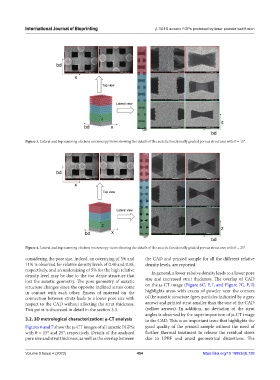
            Figure 3. Lateral and top scanning electron microscopy views showing the details of the auxetic functionally graded porous structures with θ = 15°.


            Figure 4. Lateral and top scanning electron microscopy views showing the details of the auxetic functionally graded porous structures with θ = 25°.

            considering the pore size. Indeed, an oversizing of 3% and   the CAD and printed sample for all the different relative
            11% is observed for relative density levels of 0.40 and 0.58,   density levels, are reported.
            respectively, and an undersizing of 5% for the high relative   In general, a lower relative density leads to a lower pore
            density level may be due to the too dense structure that
            lost the auxetic geometry. The pore geometry of auxetic   size and increased strut thickness. The overlap of CAD
            structure changes since the opposite inclined struts come   on the µ-CT image (Figure 6C, F, I, and Figure 7C, F, I)
            in contact with each other. Excess of material on the   highlights areas with excess of powder near the corners
            connection between struts leads to a lower pore size with   of the auxetic structure (grey particles indicated by a gray
            respect to the CAD without affecting the strut thickness.   arrow) and printed strut smaller than the one of the CAD
            This point is discussed in detail in the section 3.3.  (yellow arrows). In addition, no deviation of the strut
                                                               angles is observed by the superimposition of µ-CT image
            3.2. 3D metrological characterization: µ-CT analysis  to the CAD. This is an important issue that highlights the
            Figures 6 and 7 show the µ-CT images of all auxetic FGPSs   good quality of the printed sample without the need of
            with θ = 15° and 25°, respectively. Details of the analyzed   further thermal treatment to release the residual stress
            pore size and strut thickness, as well as the overlap between   due to  LPBF and avoid geometrical distortions. The


            Volume 9 Issue 4 (2023)                        454                          https://doi.org/10.18063/ijb.728

