


Page 466 - IJB-9-4
P. 466
International Journal of Bioprinting                   β-Ti21S auxetic FGPs produced by laser powder bed fusion


                         A                                     B


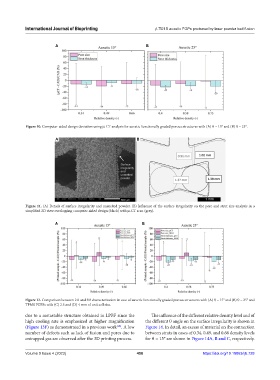
            Figure 10. Computer-aided design deviation using µ-CT analysis for auxetic functionally graded porous structures with (A) θ = 15° and (B) θ = 25°.

                         A                                 B


            Figure 11. (A) Details of surface irregularity and unmelted powder. (B) Influence of the surface irregularity on the pore and strut size analysis in a
            simplified 2D view overlapping computer-aided design (black) with µ-CT scan (grey).


                         A                                   B


            Figure 12. Comparison between 2D and 3D characterization in case of auxetic functionally graded porous structures with (A) θ = 15° and (B) θ = 25° and
            TPMS FGPSs with (C) 2.5 and (D) 4 mm of unit cell size.

            due to a metastable structure obtained in LPBF since the   The influence of the different relative density level and of
            high cooling rate is emphasized at higher magnification   the different θ angle on the surface irregularity is shown in
            (Figure 13F) as demonstrated in a previous work . A low   Figure 14. In detail, an excess of material on the connection
                                                   [18]
            number of defects such as lack of fusion and pores due to   between struts in cases of 0.34, 0.49, and 0.66 density levels
            entrapped gas are observed after the 3D printing process.   for θ = 15° are shown in Figure 14A, B and C, respectively.


            Volume 9 Issue 4 (2023)                        458                          https://doi.org/10.18063/ijb.728

