


Page 468 - IJB-9-4
P. 468
International Journal of Bioprinting                   β-Ti21S auxetic FGPs produced by laser powder bed fusion


                         A                                   B


                          C


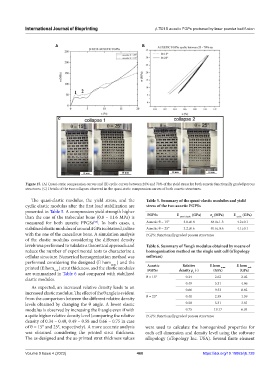
            Figure 15. (A) Quasi-static compression curves and (B) cyclic curves between 20% and 70% of the yield stress for both auxetic functionally graded porous
            structures. (C) Details of the two collapses observed in the quasi-static compression curves of both auxetic structures.
              The  quasi-elastic  modulus,  the  yield  stress,  and  the   Table 5. Summary of the quasi‑elastic modulus and yield
            cyclic elastic modulus after the first load stabilization are   stress of the two auxetic FGPSs
            presented in Table 5. A compression yield strength higher
            than the one of the trabecular bone (0.8 – 11.6 MPa) is   FGPSs  E  quasi‑elastic  (GPa)  σ  (MPa)  E  cyclic  (GPa)
                                                                                           y
            measured  for  both auxetic  FPGSs .  In both  cases,  a   Auxetic θ = 15°  3.8±0.8  48.0±1.3  4.2±0.1
                                         [55]
            stabilized elastic modulus of around 4 GPa is obtained, in line   Auxetic θ = 25°  3.2±0.6  40.6±0.6  4.1±0.1
            with the one of the cancellous bone. A simulation analysis   FGPS: Functionally graded porous structures
            of the elastic modulus considering the different density
            levels was performed to validate a theoretical approach and   Table 6. Summary of Yong’s modulus obtained by means of
            reduce the number of experimental tests to characterize a   homogenization method on the single unit cell (nTopology
            cellular structure. Numerical homogenization method was   software)
            performed considering the designed (E hom nom. ) and the
                                                                               Relative
            printed (E hom ) strut thickness, and the elastic modules   Auxetic   density ρ  (‑)  E hom  nom.    E hom  real.
                                                                FGPSs
                                                                                                       (GPa)
                                                                                            (GPa)
                        real.
            are summarized in Table 6 and compared with stabilized                 r
            elastic modules.                                   θ = 15°          0.34        2.62        2.02
                                                                                0.49        5.31        4.86
              As expected, an increased relative density leads to an
            increased elastic modulus. The effect of the θ angle is evident     0.66        9.53        8.42
            from the comparison between the different relative density   θ = 25°  0.40      2.58        1.59
            levels obtained by changing the  θ angle. A  lower elastic          0.58        5.31        3.81
            modulus is observed by increasing the θ angle even if with          0.75        19.17       6.04
            a quite higher relative density level (comparing the relative   FGPS: Functionally graded porous structures
            density of 0.34 – 0.40, 0.49 – 0.58 and 0.66 – 0.75 in case
            of θ = 15° and 25°, respectively). A more accurate analysis   were used to calculate the homogenized properties for
            was obtained considering the printed strut thickness.   each cell dimension and density level using the software
            The as-designed and the as-printed strut thickness values   nTopology (nTopology Inc. USA). Several finite element


            Volume 9 Issue 4 (2023)                        460                          https://doi.org/10.18063/ijb.728

