


Page 469 - IJB-9-4
P. 469
International Journal of Bioprinting                   β-Ti21S auxetic FGPs produced by laser powder bed fusion


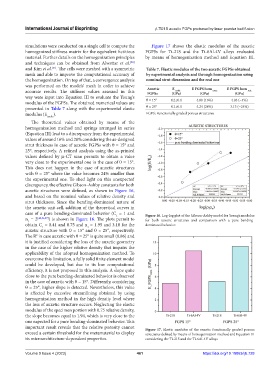
            simulations were conducted on a single cell to compute the   Figure  17 shows the elastic modulus of the auxetic
            homogenized stiffness matrix for the equivalent fictitious   FGPSs for Ti-21S and the Ti-6Al-4V alloys evaluated
            material. Further details on the homogenization principles   by means of homogenization method and Equation III.
            and techniques can be obtained from Alwattar  et al.
                                                        [50]
            and Kim et al. . The cells were meshed with a symmetric   Table 7. Elastic modulus of the two auxetic FGPSs obtained
                       [51]
            mesh and able to improve the computational accuracy of   by experimental analysis and through homogenization using
            the homogenization. On top of that, a convergence analysis   nominal strut dimension and the real one
            was performed on the models’ mesh in order to achieve
                                                                          E
            accurate results. The stiffness values assessed in this   Auxetic   (GPa)    E FGPS hom  nom.    E FGPS hom  real.
                                                                            cyclic
                                                                                      (GPa)
                                                                                                     (GPa)
                                                                FGPSs
            way were input into Equation III to evaluate the Young’s   θ = 15°  4.2±0.1  4.88 (16%)  4.03 (−4%)
            modulus of the FGPSs. The obtained numerical values are
            presented in Table 7 along with the experimental elastic   θ = 25°  4.1±0.1  5.24 (28%)  3.13 (−24%)
            modulus (E  ).                                     FGPS: Functionally graded porous structures
                     cyclic
              The theoretical values obtained by means of the
            homogenization method and  springs  arranged  in series
            (Equation III) lead to a discrepancy from the experimental
            values of around 16% and 28% considering the as-designed
            strut thickness in case of auxetic FGPSs with θ = 15° and
            25°, respectively. A  refined analysis using the as-printed
            values defined by  µ-CT scan permits to obtain a value
            very close to the experimental one in the case of θ = 15°.
            This does not happen in the case of auxetic structures
            with θ = 25° where the value becomes 24% smaller than
            the experimental one. To shed light on this unexpected
            discrepancy, the effective Gibson-Ashby constants for both
            auxetic structures were defined, as shown in  Figure  16,
            and based on the nominal values of relative density and
            strut thickness. Since the bending-dominated nature of
            the auxetic unit cell, addition of the theoretical curves in
            case of a pure bending-dominated behavior (C  = 1 and   Figure 16. Log-log plot of the Gibson-Ashby model for Young’s modulus
                                                  1
            n  = 2 [48,56,57] ) is shown in Figure 16. The plots permit to   for both auxetic structures and comparison with a pure bending-
             1
            obtain C  = 0.41 and 0.75 and n  = 1.95 and 3.10 for the   dominated behavior.
                   1
                                      1
            auxetic structure with θ = 15° and θ = 25°, respectively.
            The R  in case auxetic with θ = 25° is quite small (0.86) and
                2
            it is justified considering the loss of the auxetic geometry
            in the case of the higher relative density that impairs the
            applicability of the adopted homogenization method. To
            overcome this limitation, a fully solid finite element model
            could be developed, but due to its low computational
            efficiency, it is not proposed in this analysis. A slope quite
            close to the pure bending-dominated behavior is observed
            in the case of auxetic with θ = 15°. Differently, considering
            θ = 25°, higher slope is detected. Nevertheless, this value
            is affected by excessive streamlining obtained by using
            homogenization method in the high density level where
            the loss of auxetic structure occurs. Neglecting the elastic
            modulus of the specimen portion with 0.75 relative density,
            the slope becomes equal to 1.94, which is very close to the
            one expected for a pure bending-dominated behavior. This
            important result reveals that the relative porosity cannot   Figure  17. Elastic modulus of the auxetic functionally graded porous
            exceed a certain threshold for the metamaterial to display   structures defined by means of homogenization method and Equation III
            its microarchitecture-dependent properties.        considering the Ti-21S and the Ti-6Al-4V alloys


            Volume 9 Issue 4 (2023)                        461                          https://doi.org/10.18063/ijb.728

