


Page 467 - IJB-9-4
P. 467
International Journal of Bioprinting                   β-Ti21S auxetic FGPs produced by laser powder bed fusion


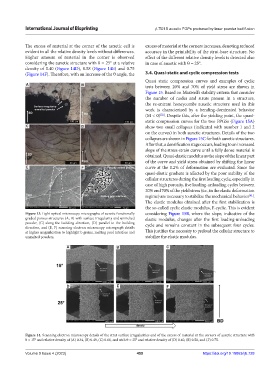
            The excess of material at the corner of the auxetic cell is   excess of material at the corners increases, denoting reduced
            evident in all the relative density levels without differences.   accuracy in the printability of the strut-base structure. No
            Higher  amount of  material  in the  corner  is observed   effect of the different relative density levels is detected also
            considering the auxetic structure with θ = 25° at a relative   in case of auxetic with θ = 25°.
            density of 0.40 (Figure 14D), 0.58 (Figure 14E) and 0.75
            (Figure 14F). Therefore, with an increase of the θ angle, the   3.4. Quasi-static and cyclic compression tests
                                                               Quasi static compression curves and examples of cyclic
            A                       B                          tests  between  20% and  70%  of  yield  stress  are  shown  in
                                                               Figure 15. Based on Maxwell’s stability criteria that consider
                                                               the number of nodes and struts present in a structure,
                                                               the re-entrant honeycombs auxetic structure used in this
                                                               work is characterized by a bending-dominated behavior
                                                               (M < 0) . Despite this, after the yielding point, the quasi-
                                                                     [22]
                                                               static compression curves for the two FPGSs (Figure 15A)
            C                       D                          show two small collapses (indicated with number 1 and 2
                                                               on the curves) in both auxetic structures. Details of the two
                                                               collapses are shown in Figure 15C for both auxetic structures.
                                                               After that, a densification stage occurs, leading to an increased
                                                               slope of the stress-strain curve until a fully dense material is
                                                               obtained. Quasi-elastic modulus as the slope of the linear part
                                                               of the curve and yield stress obtained by shifting the linear
            E                       F                          curve at the 0.2% of deformation are evaluated. Since the
                                                               quasi-elastic gradient is affected by the poor stability of the
                                                               cellular structures during the first loading cycle, especially in
                                                               case of high porosity, five loading-unloading cycles between
                                                               20% and 70% of the yield stress (i.e., in the elastic deformation
                                                               regime) are necessary to stabilize the mechanical behavior .
                                                                                                           [41]
                                                               The elastic modulus obtained after the first stabilization is
                                                               the so-called cyclic elastic modulus, E cyclic. This is evident
            Figure 13. Light optical microscopy micrographs of auxetic functionally   considering Figure 15B, where the slope, indicative of the
            graded porous structures (A, B) with surface irregularity and unmelted   elastic modulus, changes after the first loading-unloading
            powder, (C) along the building direction, (D) parallel to the building   cycle and remains constant in the subsequent four cycles.
            direction, and (E, F) scanning electron microscopy micrograph details
            at higher magnification to highlight b grains, melting pool interface and   This justifies the necessity to preload the cellular structure to
            unmelted powders.                                  stabilize the elastic modulus.

                             A                     B                    C


                             D                     E                    F


            Figure 14. Scanning electron microscopy details of the strut surface irregularities and of the excess of material at the corners of auxetic structure with
            θ = 15° and relative density of (A) 0.34, (B) 0.49, (C) 0.66, and with θ = 25° and relative density of (D) 0.40, (E) 0.58, and (F) 0.75.

            Volume 9 Issue 4 (2023)                        459                          https://doi.org/10.18063/ijb.728

