


Page 464 - IJB-9-4
P. 464
International Journal of Bioprinting                   β-Ti21S auxetic FGPs produced by laser powder bed fusion


                                              A                   B                    C


                                              D                   E                    F


                                              G                   H                    I


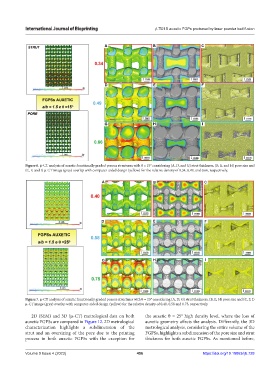
            Figure 6. µ-CT analysis of auxetic functionally graded porous structures with θ = 15° considering (A, D, and G) strut thickness, (B, E, and H) pore size and
            (C, F, and I) µ-CT image (grey) overlap with computer-aided design (yellow) for the relative density of 0.34, 0.49, and 0.66, respectively.


                                            A                     B                     C


                                            D                     E                     F


                                            G                     H                     I


            Figure 7. µ-CT analysis of auxetic functionally graded porous structures with θ = 25° considering (A, D, G) strut thickness, (B, E, H) pore size and (C, F, I)
            µ-CT image (grey) overlap with computer-aided design (yellow) for the relative density of 0.40, 0.58 and 0.75, respectively.

              2D (SEM) and 3D (µ-CT) metrological data on both   the auxetic θ = 25° high density level, where the loss of
            auxetic FGPSs are compared in Figure 12. 2D metrological   auxetic geometry affects the analysis. Differently, the 3D
            characterization highlights a subdimension of the   metrological analysis, considering the entire volume of the
            strut  and  an  oversizing  of  the  pore  due  to  the  printing   FGPSs, highlights a subdimension of the pore size and strut
            process in both auxetic FGPSs with the exception for   thickness for both auxetic FGPSs. As mentioned before,


            Volume 9 Issue 4 (2023)                        456                          https://doi.org/10.18063/ijb.728

