


Page 420 - IJB-9-5
P. 420
International Journal of Bioprinting                         3D-printed Mg scaffolds promote bone defect repair


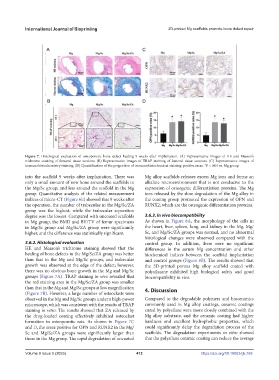
            Figure 7. Histological evaluation of osteoporotic bone defect healing 9 weeks after implantation. (A) Representative images of HE and Masson’s
            trichrome staining of femoral tissue sections. (B) Representative images of TRAP staining of femoral tissue sections. (C) Representative images of
            immunohistochemistry staining. (D) Quantification of the proportion of immunohistochemical staining-positive areas. *P < 0.05 vs. Mg group.

            into the scaffold 9 weeks after implantation. There was   Mg alloy scaffolds releases excess Mg ions and forms an
            only a small amount of new bone around the scaffolds in   alkaline microenvironment that is not conducive to the
            the Mg/Sc group, and less around the scaffold in the Mg   expression of osteogenic differentiation proteins. The Mg
            group. Quantitative analysis of the related measurement   ions released by the slow degradation of the Mg alloy in
            indices of micro-CT (Figure 6E) showed that 9 weeks after   the coating group promoted the expression of OPN and
            the operation, the number of trabeculae in the Mg/Sc/ZA   RUNX2, which are the osteogenic differentiation proteins.
            group was the highest, while the trabecular separation
            degree was the lowest. Compared with uncoated scaffolds   3.6.3. In vivo biocompatibility
            in Mg group, the BMD and BV/TV of femur specimens   As shown in  Figure 8A, the morphology of the cells in
            in Mg/Sc group and Mg/Sc/ZA group were significantly   the heart, liver, spleen, lung, and kidney in the Mg, Mg/
            higher, and the difference was statistically significant.  Sc, and Mg/Sc/ZA groups was normal, and no abnormal
                                                               histological  changes  were  observed compared with the
            3.6.2. Histological evaluation                     control  group.  In  addition,  there  were  no  significant
            HE and Masson’s trichrome staining showed that the   differences  in the serum Mg concentration and other
            healing of bone defects in the Mg/Sc/ZA group was better   biochemical indices between the scaffold implantation
            than that in  the Mg  and Mg/Sc  groups, and trabecular   and control groups (Figure 8B). The results showed that
            growth was observed at the edge of the defect; however,   the 3D-printed porous Mg alloy scaffold coated with
            there was no obvious bone growth in the Mg and Mg/Sc   polysilazane exhibited high biological safety and good
            groups (Figure 7A). TRAP staining in vivo revealed that   biocompatibility in vivo.
            the red staining area in the Mg/Sc/ZA group was smaller
            than that in the Mg and Mg/Sc groups at low magnification   4. Discussion
            (Figure 7B). However, a large number of osteoclasts were
            observed in the Mg and Mg/Sc groups under a high-power   Compared to the degradable polymers and bioceramics
            microscope, which was consistent with the results of TRAP   commonly used in Mg alloy coatings, ceramic coatings
            staining in vitro. The results showed that ZA released by   cured by polysilane were more closely combined with the
            the drug-loaded coating effectively inhibited osteoclast   Mg alloy substrate, and the ceramic coating had higher
            formation in osteoporotic rats. As shown in  Figure 7C   hardness and excellent hydrophobic properties, which
            and D, the areas positive for OPN and RUNX2 in the Mg/  could significantly delay the degradation process of the
            Sc  and  Mg/Sc/ZA  groups  were  significantly  larger  than   scaffolds. The degradation experiments  in vitro showed
            those in the Mg group. The rapid degradation of uncoated   that the polysilane ceramic coating can reduce the average


            Volume 9 Issue 5 (2023)                        412                         https://doi.org/10.18063/ijb.769

