


Page 110 - IJB-9-6
P. 110
International Journal of Bioprinting                              Affordable temperature-controlled bioprinter


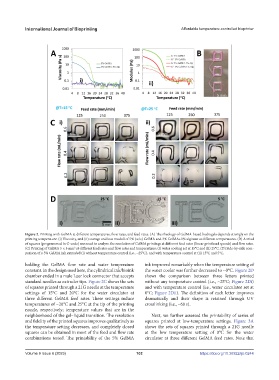
            Figure 2. Printing with GelMA at different temperatures, flow rates, and feed rates. (A) The rheology of GelMA-based hydrogels depends strongly on the
            printing temperature: (i) Viscosity, and (ii) storage and loss moduli of 5% (w/v) GelMA and 3% GelMA+1% alginate at different temperatures. (B) A triad
            of squares (programmed in G-code) was used to analyze the resolution of GelMA printings at different feed rates (linear printhead speeds) and flow rates.
            (C) Printing of GelMA 5 × 5 mm  at different feed rates and flow rates and temperatures: (i) water cooling set at 15°C and (ii) 25°C. (D) Side-by-side com-
                                 2
            parison of a 5% GelMA ink extruded (i) without temperature control (i.e., ~25°C), and with temperature control at (ii) 15°C and 5°C.

            holding  the  GelMA  flow  rate  and  water  temperature   ink improved remarkably when the temperature setting of
            constant. In the design used here, the cylindrical ink/bioink   the water cooler was further decreased to ~0°C. Figure 2D
            chamber ended in a male Luer lock connector that accepts   shows  the comparison  between  three  letters  printed
            standard needles as extruder tips. Figure 2C shows the sets   without any temperature control (i.e., ~25°C; Figure 2Di)
            of squares printed through a 21G needle at the temperature   and with temperature control (i.e., water circulator set at
            settings of 15°C and 20°C for the water circulator at   0°C; Figure 2Dii). The definition of each letter improves
            three different GelMA feed rates. These settings induce   dramatically and their shape is retained through UV
            temperatures of ~20°C and 25°C at the tip of the printing   crosslinking (i.e., ~60 s).
            nozzle, respectively; temperature values that are in the
            neighborhood of the gel–liquid transition. The resolution   Next, we further assessed the printability of series of
            and fidelity of the printed squares improves qualitatively as   squares printed at low-temperature settings.  Figure 3A
            the temperature setting decreases, and completely closed   shows the sets of squares printed through a 21G needle
            squares can be obtained in most of the feed and flow rate   at the low temperature setting of 0°C for the water
            combinations tested. The printability of the 5% GelMA   circulator at three different GelMA feed rates. Note that


            Volume 9 Issue 6 (2023)                        102                        https://doi.org/10.36922/ijb.0244

