


Page 111 - IJB-9-6
P. 111
International Journal of Bioprinting                              Affordable temperature-controlled bioprinter


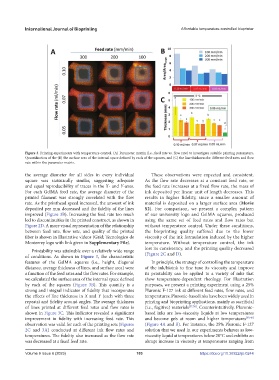
            Figure 3. Printing experiments with temperature control. (A) Parameter matrix (i.e., feed rate vs. flow rate) to investigate suitable printing parameters.
            Quantification of the (B) the surface area of the internal space defined by each of the squares, and (C) the line thickness for different feed rates and flow
            rate within the parameter matrix.


            the average diameter for all sides in every individual   These observations were expected and consistent.
            square  was  statistically  similar,  suggesting  adequate   As the flow rate decreases at a constant feed rate, or
            and equal reproducibility of traces in the X- and Y-axes.   the feed rate increases at a fixed flow rate, the mass of
            For each GelMA feed rate, the average diameter of the   ink deposited per linear unit of length decreases. This
            printed  filament  was  strongly  correlated  with  the  flow   results in higher fidelity, since a smaller amount of
            rate. As the printhead speed increased, the amount of ink   material is deposited on a larger surface area (Movie
            deposited per mm decreased and the fidelity of the lines   S2). For comparison, we present a complex pattern
            improved (Figure 3B). Increasing the feed rate too much   of  our  university  logo  and  GelMA  squares,  produced
            led to discontinuities in the printed construct, as shown in   using  the same set  of  feed  rates  and  flow  rates  but
            Figure 2D. A more visual representation of the relationship   without temperature control. Under these conditions,
            between feed rate, flow rate, and quality of the printed   the bioprinting quality suffered due to the lower
            fiber is shown in illustrative videos (Grid; Tecnologico de   viscosity of the ink formulation induced by the higher
            Monterrey logo with link given in Supplementary File).  temperature.  Without  temperature  control,  the  ink
               Printability was attainable over a relatively wide range   lost its consistency, and the printing quality decreased
            of conditions. As shown in  Figure  3, the characteristic   (Figure 2C and D).
            features  of  the  GelMA  squares  (i.e.,  height,  diagonal   In principle, the strategy of controlling the temperature
            distance, average thickness of lines, and surface area) were   of  the  ink/bioink  to  fine  tune  its  viscosity  and  improve
            a function of the feed rates and the flow rates. For example,   its printability can be applied to a variety of inks that
            we calculated the surface area of the internal space defined   show temperature-dependent rheology. For illustration
            by each of the squares (Figure 3B). This quantity is a   purposes, we present a printing experiment using a 25%
            strong and integral indicator of fidelity that incorporates   Pluronic F-127 ink at different feed rates, flow rates, and
            the effects of line thickness in X and Y (each with three   temperatures. Pluronic-based inks have been widely used in
            repeats) and fidelity around angles. The average thickness   printing and bioprinting applications, mainly as sacrificial
            of lines printed at different feed rates and flow rates is   (i.e., fugitive) materials [37,38] . Counterintuitively, Pluronic-
            shown in Figure 3C. This indicator revealed a significant   based inks are low-viscosity liquids at low temperatures
            improvement in fidelity with increasing feed rate. This   and become gels at room and higher temperatures [39,40]
            observation was valid for each of the printing sets (Figures   (Figure 4A and B). For instance, the 25% Pluronic F-127
            2C and  3A) conducted at different ink flow rates and   solution that we used in our experiments behaves as low-
            temperatures. The fidelity also increased as the flow rate   viscosity liquid at temperatures below 20°C and exhibits an
            was decreased at a fixed feed rate.                abrupt increase in viscosity at temperatures ranging from

            Volume 9 Issue 6 (2023)                        103                        https://doi.org/10.36922/ijb.0244

