


Page 114 - IJB-9-6
P. 114
International Journal of Bioprinting                              Affordable temperature-controlled bioprinter


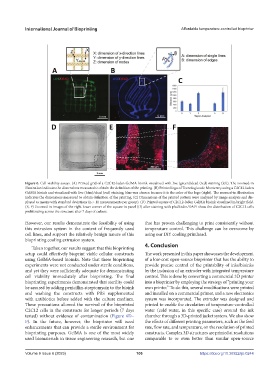
            Figure 6. Cell viability assays. (A) Printed grid of a C2C12-laden GelMA bioink visualized with live (green)/dead (red) staining (left). The zoomed-in
            illustration indicates the dimensions measured to obtain the definition of the printing. (B) Printed logo of Tecnologico de Monterrey using a C2C12-laden
            GelMA bioink and visualized with live (blue)/dead (red) staining; blue was chosen because it is the color of the logo (right). The zoomed-in illustration
            indicates the dimensions measured to obtain definition of the printing. (C) Dimensions of the printed pattern were analyzed by image analysis and dis-
            played as means with standard deviations (n > 11 measurements per group). (D) Printed square of C2C12-laden GelMA bioink visualized in bright field.
            (E, F) Zoomed-in images of the right lower corner of the square in panel (D) after staining with phalloidin/DAPI show the distribution of C2C12 cells
            proliferating across the structure after 7 days of culture.
            However, our results demonstrate the feasibility of using   that has proven challenging to print consistently without
            this extrusion system in the context of frequently used   temperature control. This challenge can be overcome by
            cell lines, and support the relatively benign nature of this   using our DiY cooling printhead.
            bioprinting cooling extrusion system.
                                                               4. Conclusion
               Taken together, our results suggest that this bioprinting
            setup could effectively bioprint viable cellular constructs   The work presented in this paper showcases the development
            using GelMA-based bioinks. Note that these bioprinting   of a low-cost open-source bioprinter that has the ability to
            experiments were not conducted under sterile conditions,   provide precise control of the printability of inks/bioinks
            and yet they were sufficiently adequate for demonstrating   by the inclusion of an extruder with integrated temperature
            cell viability immediately after bioprinting. The final   control. This is done by converting a commercial 3D printer
            bioprinting experiments demonstrated that sterility could   into a bioprinter by employing the strategy of “printing your
            be assured by adding penicillin-streptomycin to the bioink   own printer.” To do this, several modifications were printed
            and  washing  the  constructs  with  PBS  supplemented   and installed on a commercial printer, and a new electronics
            with antibiotics before added with the culture medium.   system was incorporated. The extruder was designed and
            These precautions allowed the survival of the bioprinted   printed to enable the circulation of temperature-controlled
            C2C12 cells in the constructs for longer periods (7 days   water  (cold  water,  in  this  specific  case)  around  the  ink
            tested) without evidence of contamination (Figure  6D–  chamber through a 3D-printed jacket system. We also show
            F). In the future, however, the bioprinter will need   the effects of different printing parameters, such as the feed
            enhancements that can provide a sterile environment for   rate, flow rate, and temperature, on the resolution of printed
            bioprinting purposes. GelMA is one of the most widely   constructs. Complex 3D structures are printed at resolutions
            used biomaterials in tissue engineering research, but one   comparable  to  or  even  better  than  similar  open-source


            Volume 9 Issue 6 (2023)                        106                        https://doi.org/10.36922/ijb.0244

