


Page 112 - IJB-9-6
P. 112
International Journal of Bioprinting                              Affordable temperature-controlled bioprinter


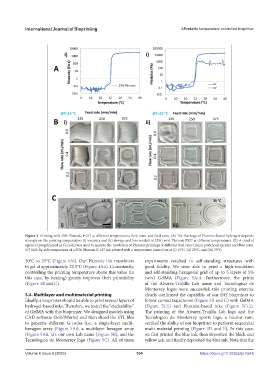
            Figure 4. Printing with 25% Pluronic F-217 at different temperatures, flow rates, and feed rates. (A) The rheology of Pluronic-based hydrogels depends
            strongly on the printing temperature: (i) viscosity and (ii) storage and loss moduli of 25% (w/v) Pluronic F127 at different temperatures. (B) A triad of
            squares (programmed in G-code) was used to analyze the resolution of Pluronic printings at different feed rates (linear printhead speeds) and flow rates.
            (C) Side-by-side comparison of a 25% Pluronic F-127 ink printed with a temperature control set at (i) 15°C, (ii) 25°C, and (iii) 35°C.
            20°C to 25°C (Figure 4Ai). Our Pluronic ink transitions   experiments resulted in self-standing structures with
            to gel at approximately 22.5°C (Figure 4Aii). Consistently,   good  fidelity. We  were  able  to  print  a  high-resolution
            controlling the printing temperature above this value (in   and self-standing hexagonal grid of up to 5 layers of 5%
            this case, by heating) greatly improves their printability   (w/v) GelMA (Figure 5Aii). Furthermore, the prints
            (Figure 4B and C).                                 of the Alvarez-Trujillo Lab name and Tecnologico de
                                                               Monterrey logos were successful; this printing exercise
            3.4. Multilayer and multimaterial printing         clearly confirmed the capability of our DiY bioprinter to
            Ideally, a bioprinter should be able to print several layers of   follow curved trajectories (Figure 5B and C) with GelMA
            hydrogel-based inks. Therefore, we tested the “stackability”   (Figure  5Cii) and Pluronic-based inks (Figure  5Ciii).
            of GelMA with this bioprinter. We designed models using   The printing of the Alvarez-Trujillo Lab logo and the
            CAD software (SolidWorks) and then sliced the STL files   Tecnologico de Monterrey sports logo, a bicolor ram,
            to generate different G-codes (i.e., a single-layer multi-  verified the ability of our bioprinter to perform sequential
            hexagon  array  (Figure  5Ai),  a  multilayer  hexagon  array   multi-material printing (Figure 5D and  E). In this case,
            (Figure 5Aii, iii), our own Lab name (Figure 5B), and the   we first printed the blue ink, then deposited the black and
            Tecnologico de Monterrey logo (Figure 5C). All of these   yellow ink, and finally deposited the blue ink. Note that the

            Volume 9 Issue 6 (2023)                        104                        https://doi.org/10.36922/ijb.0244

