


Page 133 - IJB-9-6
P. 133
International Journal of Bioprinting                                   Exosome-based bioink for bioprinting


                Reference  [36]  [67]  [40]  [68]  [69]  [70]  [36]  [72]  [75]  [78]  [79]  [76]  [80]  [77]  [46]  [90]  [98]


 [44]  [115]  [116]    [117]  [38]  [118]  [36]


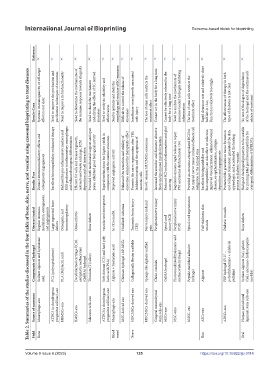
 Did not achieve the effective  influence on the prognosis of  traumatic brain injury (TBI).  No statistical differences were  displayed between hypo-Exo and   Exo.  Clinical trial data are lacking.  The mechanical properties and  stability need to be further improved.  The purity and quality of exosomes  need to be further studied and  evaluated to ensure their safety and   efficacy. Need to address the cost and safety of   the method.  Need to study the relationship  be


 Thermosensitive, injectable, self-healing,  antioxidant, low cytotoxicity, and  ultralong sustained release of SHED-Exo;  enhanced the therapeutic potential of   SHED-Exo.  Improved angiogenesis, nerve  regeneration, and functional motor  restoration; Enhanced the therapeutic  regenerative outcomes of MSC-derived  exosomes, promoting the regeneration of   the injured spinal cord. Promoted the healing of Streptozotocin  (STZ)-induced diabetic rat skin wounds,  promoted th


 Traumatic brain injury   (TBI)  Traumatic Spinal Cord   Injury (SCI)  Diabetes  Myocardial infarction  Thin endometrium  Diabetic wound  In vitro model  Table 2. Summaries of the studies discussed in the four fields of bone, skin, nerve, and vascular using exosomal bioprinting to treat diseases  Diseases treated  Regular immuno-   modulation, osteogenesis,   and angiogenesis  Large segmental bone   defects  Osteogenic and     immunoregulatory  Osteoarthritis  Bone defect


 Bioactive antioxidant   poly(citric acid-gallic acid)-  based hybrid hydrogel  Binding peptide  PPFLMLLKGSTR-modified   hyaluronic acid hydrogel  Chitosan/Silk Hydrogel Sponge  PGN hydrogel (PA-GHRPS   peptide+peptide NapFF)  Four-arm SH-PEG cross-linked   with Ag +  hydrogel  Anti-microbial peptide-based   FHE hydrogel  Alginate+hyaluronic acid  Components of hydrogel Sodium alginate and hyaluronic   acid.  PCL (polycaprolactone)  PLA (Polylactic acid)  Decellularized c


 SHED-Exo  Hypoxia-stimulated   MSCs-derived   exosomes (sub-exo)  Gingival   mesenchymal stem   cells(GMSCs)-Exos  Umbilical cord   mesenchymal   stem cell-derived   exosomes (UMSC-  Exo)  ADSC-exo  AMSCs-exo  Macrophage-exo  Source of exosomes  Macrophage-exo  ATDC5 (a chondrogenic   progenitor cell line)-exo  HBMSCs-exo  BMSCs-exo  Schwann cells-exo  ATDC5(a chondrogenic   progenitor cell line)-exo  Macrophage-exo  MSC-derived exo  HUCMSCs-derived exo  HUCMSCs-derived


                Field  Bone                       Blood   vessel  Nerve                 Skin             Oral
 Blood   vessel


            Volume 9 Issue 6 (2023)                        125                         https://doi.org/10.36922/ijb.0114

