


Page 160 - IJB-9-6
P. 160
International Journal of Bioprinting                                       3D printing in gastroenterology


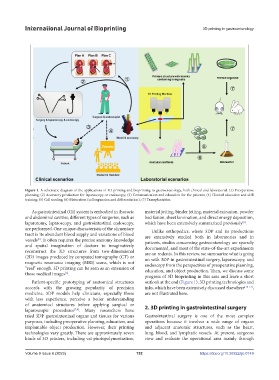
            Figure 1. A schematic diagram of the applications of 3D printing and bioprinting in gastroenterology, both clinical and laboratorial. (1) Preoperative
            planning; (2) Accessory production for laparoscopy or endoscopy; (3) Communication and education for the patients; (4) Clinical education and skill
            training; (5) Cell seeding; (6) Maturation (cell expansion and differentiation); (7) Transplantation.

               As gastrointestinal (GI) system is embodied in thoracic   material jetting, binder jetting, material extrusion, powder
            and abdominal cavities, different types of surgeries, such as   bed fusion, sheet lamination, and direct energy deposition,
            laparotomy, laparoscopy, and gastrointestinal endoscopy,   which have been extensively summarized previously .
                                                                                                        [9]
            are performed. One unique characteristic of the alimentary   Unlike  orthopedics,  where  3DP and  its productions
            tract is its abundant blood supply and variations of blood   are extensively studied both in laboratories and in
            vessels . It often requires the precise anatomy knowledge   patients, studies concerning gastroenterology are sparsely
                 [5]
            and spatial imagination of doctors to imaginatively   documented, and most of the state-of-the-art experiments
            reconstruct the 3D structures from two-dimensional   are on rodents. In this review, we summarize what is going
            (2D) images produced by computed tomography (CT) or   on with 3DP in gastrointestinal surgery, laparoscopy, and
            magnetic  resonance  imaging  (MRI)  scans,  which  is  not   endoscopy from the perspectives of preoperative planning,
            “real” enough. 3D printing can be seen as an extension of   education, and object production. Then, we discuss some
            those medical images .
                             [6]
                                                               progress of 3D bioprinting in this area and leave a short
               Patient-specific prototyping of anatomical structures   outlook at the end (Figure 1). 3D printing technologies and
            accords  with  the growing  popularity  of  precision   inks, which have been extensively discussed elsewhere [10-13] ,
            medicine. 3DP models help clinicians, especially those   are not illustrated here.
            with less experience, perceive a better understanding
            of anatomical structures before applying surgical or   2. 3D printing in gastrointestinal surgery
            laparoscopic procedures [7,8] . Many researchers have
            tried 3DP gastrointestinal organs and tissues for various   Gastrointestinal surgery is one of the most complex
            purposes, including preoperative planning, education, and   operations because it involves a wide range of organs
            implantable  object  production.  However,  their  printing   and adjacent anatomic structures, such as the heart,
            technologies vary greatly. There are approximately seven   lung, blood, and lymphatic vessels. At present, surgeons
            kinds of 3D printers, including vat photopolymerization,   view and evaluate the operational area mainly through


            Volume 9 Issue 6 (2023)                        152                        https://doi.org/10.36922/ijb.0149

