


Page 162 - IJB-9-6
P. 162
International Journal of Bioprinting                                       3D printing in gastroenterology


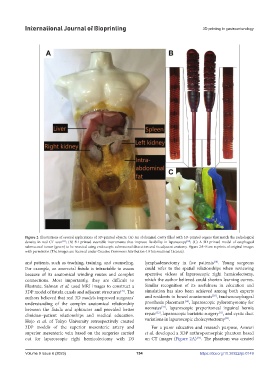
            Figure 2. Illustrations of several applications of 3D-printed objects. (A) An abdominal cavity filled with 3D-printed organs that match the radiological
                            [35]
                                                                                 [60]
            density  in  real  CT  scan ;  (B)  3D-printed  steerable  instruments  that  improve  flexibility  in  laparoscopy ;  (C)  A  3D-printed  model  of  esophageal
            submucosal tumor (green) to be resected using endoscopic submucosal dissection and its adjacent anatomy. Figure 2A–B are reprints of original images
            with permission (The images are licensed under Creative Commons Attribution 4.0 International License).
                                                                                            [28]
            and patients, such as teaching, training, and counseling.   lymphadenectomy in five patients . Young surgeons
            For example, an anorectal fistula is intractable to assess   could  refer  to  the  spatial  relationships  when  reviewing
            because of its anatomical winding routes and complex   operative videos of laparoscopic right hemicolectomy,
            connections. Most importantly, they are difficult to   which the author believed could shorten learning curves.
            illustrate. Sahnan et al. used MRI images to construct a   Similar recognition of its usefulness in education and
            3DP model of fistula canals and adjacent structures . The   simulation has also been achieved among both experts
                                                    [27]
                                                                                            [29]
            authors believed that real 3D models improved surgeons’   and residents in bowel anastomosis , tracheoesophageal
                                                                                [30]
            understanding of the complex anatomical relationship   prosthesis placement , laparoscopic pyloromyotomy for
                                                                      [31]
            between the fistula and sphincter and provided better   neonates , laparoscopic preperitoneal inguinal hernia
                                                                                              [33]
                                                                    [32]
            clinician–patient  relationships  and medical education.   repair , laparoscopic bariatric surgery , and cystic duct
                                                                                                 [34]
            Hojo  et al. of Tokyo University retrospectively created   variations in laparoscopic cholecystectomy .
            3DP models of the superior mesenteric artery and      For  a  purer  educative  and  research  purpose,  Anwari
            superior mesenteric vein based on the surgeries carried   et al. developed a 3DP anthropomorphic phantom based
            out for laparoscopic right hemicolectomy with D3   on CT images (Figure 2A) . The phantom was created
                                                                                     [35]
            Volume 9 Issue 6 (2023)                        154                        https://doi.org/10.36922/ijb.0149

