


Page 166 - IJB-9-6
P. 166
International Journal of Bioprinting                                       3D printing in gastroenterology


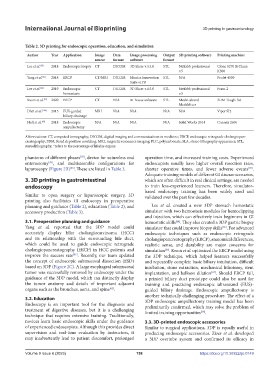
            Table 2. 3D printing for endoscopic operation, education, and simulation
             Author    Year  Application  Image   Data   Image processing   Output  3D printing software  Printing machine          Printing material  Printing technique  Model name               Model size*  Printing time  Printing cost
                                          source  format  software     format
             Lee et al. [65]  2018  Endoscopic biopsy  CT  DICOM  3D Slicer v.4.5.0  STL  Netfabb professional   Clone S270 & Clone   Platinum silicone rubber  FDM   Stomach                       N/A       N/A          N/A
                                                                             v.5              K300
             Yang et al. [61]  2018  ERCP  CT/MRI  DICOM  Mimics Innovation  STL  N/A         ProJet 4500                           Visijet C4 Spectrum Core  N/A     Hilar cholangiocarcinoma and bile duct  N/A  N/A     N/A
                                                         Suite v17.0
             Lee et al. [64]  2019  Endoscopic   CT  DICOM  3D Slicer v.4.5.0  STL  Netfabb professional   Form 2                   Silicone          SLA             Stomach                       N/A       N/A          N/A
                            hemostasis                                       v.5
             Kwon et al. [67]  2020  ERCP  CT    N/A     In-house software  STL  MeshLab and   3DM Tough-3.6                        Silicone          N/A             Stomach and duodenum          N/A       N/A          N/A
                                                                             MeshMixer
             Dhir et al. [109]  2015  EUS-guided   MRI  N/A  N/A       N/A   N/A              Viper SI2                             PLC               SLA             Bile duct                     N/A       N/A          N/A
                            biliary drainage
             Holt et al. [68]  2018  Endoscopic   N/A  N/A  N/A        N/A   Solid Works 2014  Connex 260v                          Silicone rubber, polymer   Polyjet  Stomach, duodenal ampulla   N/A       N/A          1482 USD
                            ampullectomy                                                                                            resin

            Abbreviations: CT, computed tomography; DICOM, digital imaging and communications in medicine; ERCP, endoscopic retrograde cholangiopan-
            creatography; FDM, fused deposition modeling; MRI, magnetic resonance imaging; PLC, polycarbonate; SLA, stereo lithography appearance; STL,
            stereolithography; *refers to the percentage of lifesize organs.

            phantoms of different phases , device for sutureless end   operation time, and increased training costs. Experienced
                                   [58]
            enterostomy , and multisteerable  configurations for   endoscopists  usually have  higher  overall  resection rates,
                      [59]
            laparoscopy (Figure 2B) . These are listed in Table 3.  shorter operative times, and fewer adverse events .
                               [60]
                                                                                                           [63]
                                                               Adequate training models of different GI disease scenarios,
            3. 3D printing in gastrointestinal                 which are often difficult in real clinical settings, are needed
            endoscopy                                          to train less-experienced learners. Therefore, simulator-
                                                               based endoscopy training has been widely used and
            Similar to open surgery or laparoscopic surgery, 3D   validated over the past few decades.
            printing also  facilitates GI  endoscopy  in preoperative
            planning and guidance (Table 2), education (Table 2), and   Lee  et al. created a new 3DP stomach hemostatic
            accessory production (Table 3).                    simulator with two hemostasis modules for hemoclipping
                                                               and injection, which can effectively train beginners in GI
            3.1. Preoperative planning and guidance            hemostatic skills . They also created a 3DP gastric biopsy
                                                                            [64]
            Yang  et al. reported that the 3DP  model could    simulator that could improve biopsy skills . For advanced
                                                                                                [65]
            accurately display  hilar  cholangiocarcinoma (HCC)   endoscopic techniques such as endoscopic retrograde
            and its relationship with the surrounding bile duct,   cholangiopancreatography (ERCP), anatomical differences,
            which could be used to guide endoscopic retrograde   realistic  sense,  and  durability  are  major  concerns  for
            cholangiopancreatography (ERCP) in HCC patients and   simulation . Kwon et al. optimized the ERCP model using
                                                                       [66]
            improve the success rate . Recently, our team updated   the 3DP technique, which helped learners successfully
                                [61]
            the  concept  of endoscopic submucosal  dissection (ESD)   and repeatedly complete basic biliary intubation, difficult
            based on 3DP (Figure 2C). A large esophageal submucosal   intubation, stone extraction, mechanical lithotomy, stent
            tumor was successfully removed by endoscopy under the   implantation, and balloon dilation . Should ERCP fail,
                                                                                           [67]
            guidance of the 3DP model, which can distinctly display   a printed biliary duct prototype could also be used for
            the tumor anatomy and details of important adjacent   training and practicing endoscopic ultrasound (EUS)-
            organs such as the bronchus, aorta, and spine .    guided biliary drainage. Endoscopic ampullectomy is
                                                [62]
                                                               another technically challenging procedure. The effect of a
            3.2. Education                                     3DP endoscopic ampullectomy training model has been
            Endoscopy is an important tool for the diagnosis and   preliminarily confirmed, which may solve the problem of
            treatment of digestive diseases, but it is a challenging   limited training opportunities .
                                                                                       [68]
            technique that requires extensive training. Traditionally,
            novices learn basic endoscopic skills under the guidance   3.3. 3D-printed endoscopic accessories
            of experienced endoscopists. Although this provides direct   Similar to surgical applications, 3DP is equally useful in
            supervision and real-time evaluation by instructors, it   producing endoscopic accessories. Zizer et al. developed
            may inadvertently lead to patient discomfort, prolonged   a 3DP overtube system and confirmed its efficacy in


            Volume 9 Issue 6 (2023)                        158                        https://doi.org/10.36922/ijb.0149

