


Page 170 - IJB-9-6
P. 170
International Journal of Bioprinting                                       3D printing in gastroenterology


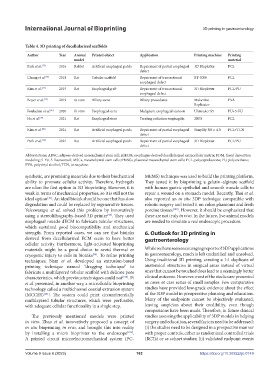
            Table 4. 3D printing of decellularized scaffolds
             Author       Year   Animal   Printed object     Application            Printing machine  Printing                     Printing technique  Seeded cells   Extracellular   Bioreactor       Results
                                 model                                                            material                                                            matrix
             Park et al. [75]  2016  Rabbit  Artificial esophageal patch  Repairment of partial esophageal   3D Bioplotter  PCL    Extrusion        Rabbit MSCs       Fibrin, thrombin  None           Better cell regeneration in MSC group
                                                             defect
             Chung et al. [76]  2018  Rat  Tubular scaffold  Repairment of transectional   BT-3000  PCL                            3D printing &    None              None          Omentum            Better cell regeneration in MSC group
                                                             esophageal defect                                                     electrospinning
             Kim et al. [77]  2019  Rat  Esophageal graft    Repairment of transectional   3D Bioplotter  PCL/PU                   3D printing &    Human MSCs        None          Custom-made & omentum  Satisfactory tissue regeneration with both
                                                             esophageal defect                                                     electrospinning                                                     bioreactors
             Boyer et al. [95]  2019  In vitro  Biliary stent  Biliary procedures   MakerBot      PVA                              N/A              Human PMSCs, human   Collagen   Growth medium      Satisfactory cholangiocytes coating
                                                                                    Replicator                                                      primary cholangiocytes
             Fouladian et al. [81]  2020  In vitro  Esophageal stent  Malignant esophageal stenosis  Ultimaker S5  PU+5-FU         FDM              None              None          None               Sustained release of 5-FU over 110 days
             Ha et al. [79]  2021  Rat  Esophageal stent     Treating radiation esophagitis  2RPS  PCL                             Extrusion        None              EdECM-based   None               Rapid resolution of inflammatory response
                                                                                                                                                                      hydrogel
             Kim et al. [80]  2021  Rat  Artificial esophageal patch  Repairment of partial esophageal   Simplify 3D v. 4.0  PCL+TCN  Extrusion     None              None          None               Better tissue regeneration and antibacterial
                                                             defect                                                                                                                                    activity
             Park et al. [78]  2021  Rat  Artificial esophageal patch  Repairment of partial esophageal   3D Bioplotter  PCL/PU    3D printing &    ADSC              Matrigel &    Growth medium      Better cell regeneration in ADSC group
                                                             defect                                                                electrospinning                    fibronectin

            Abbreviations: ADSC, adipose-derived mesenchymal stem cell; EdECM, esophagus-derived decellularized extracellular matrix; FDM, fused deposition
            modeling; 5-FU, 5-fluorouracil; MSCs, mesenchymal stem cells; PMSCs, placental mesenchymal stem cells; PCL, polycaprolactone; PU, polyurethane;
            PVA, polyvinyl alcohol; TCN, tetracycline.

            synthetic, are promising materials due to their biochemical   MEMS) technique was used to build the printing platform.
            ability to promote cellular activity. Therefore, hydrogels   They tested it by bioprinting a gelatin–alginate scaffold
            are often the first option in 3D bioprinting. However, it is   with human gastric epithelial and smooth muscle cells to
            weak in terms of mechanical properties, so it is still not the   repair a wound on a stomach model. Recently, Thai et al.
            ideal option . An ideal bioink should be one that has slow   also reported an  in situ 3DP technique compatible with
                     [10]
            degradation and could be replaced by regenerative tissues.   robotic surgery and tested it on colon phantoms and fresh
            Yeleswarapu  et al. solved this problem by innovatively   porcine tissues [103] . However, it should be emphasized that
            using a stereolithography-based 3D printer . They used   these are not truly in vivo. In the future, live animal models
                                               [98]
            esophageal muscle dECM to fabricate tubular structures,   are needed to simulate a real endoscopic procedure.
            which sustained good biocompatibility and mechanical
            strength. From reported cases, we can see that bioinks   6. Outlook for 3D printing in
            derived from decellularized ECM seem to have better   gastroenterology
            cellular activity. Furthermore, light-activated bioprinting
            materials might be a good choice to avoid thermal or   While we have seen encouraging reports of 3DP applications
            cryogenic injury to cells in bioinks . To refine printing   in gastroenterology, much is left unclarified and unsolved.
                                         [99]
            techniques, Nam  et al. developed an extrusion-based   Using traditional 3D printing, creating a 1:1 duplicate of
            printing technique named “dragging technique” to   anatomical structures in surgical areas instead of virtual
            fabricate a multilayered tubular scaffold with delicate pore   ones that cannot be touched does lead to a seemingly better
            characteristics, which previous techniques could not [100] . Pi   clinical outcome. However, most of the studies are presented
            et al. presented, in another way, a microfluidic bioprinting   as cases or case series of small samples. Few comparative
            technology called a multichannel coaxial extrusion system   studies have provided low-grade evidence about the effect
            (MCCES) [101] . The system could print circumferentially   of the 3DP model in preoperative planning and education.
            multilayered tubular structures, which were perfusable,   Many of the endpoints cannot be objectively evaluated,
            with adequate cellular functionality in a single step.  leaving  suspicion  about  their  credibility, even though
                                                               comparisons have been made. Therefore, in future clinical
               The  previously  mentioned  models  were  printed   studies assessing the applicability of 3DP models in helping
            in  vitro. Zhao  et al. innovatively proposed a concept of   surgery and education, several factors need to be addressed:
            in situ bioprinting  in vivo, and brought this into reality   (i) the studies need to be designed in a prospective manner
            by installing a micro bioprinter to the endoscope [102] .   with proper controls, either as randomized controlled trials
            A printed circuit microelectromechanical system (PC-  (RCTs) or as cohort studies; (ii) validated endpoint events


            Volume 9 Issue 6 (2023)                        162                        https://doi.org/10.36922/ijb.0149

