


Page 215 - IJB-9-6
P. 215
International Journal of Bioprinting                     Multi-Cellular tissues/organoids manufacturing strategies


            emerged . The advantages of the scaffold-free strategy
                   [53]
            compensate for the limitations of scaffold-based strategies.
            The scaffold-free strategy is particularly suitable for
            fabricating complex heterogeneous structures containing
            multiple cell types [54,55] . This bottom-up assembly approach
            holds promise as a module for constructing intricate    Bioprinting-assisted tissue emergence  Enables spontaneous formation of   Precise control over initial spatial  organization and density of building   Does not require overly complex   Placement of spheres in the scaffold   Requires suitable conditions and
            MTOs . The key bioassembly technologies based on the                                      post-printing remodeling for
                 [56]
            scaffold-free strategy include the Kenzan and aspiration-                         bioprinting modalities  is done manually  geometric complexity
            assisted technology, fluid-based manipulation, suspended                larger MTOs
            bioprinting, and bioprinting-assisted tissue emergence.      100–500 µm  10–50 μm/s  units
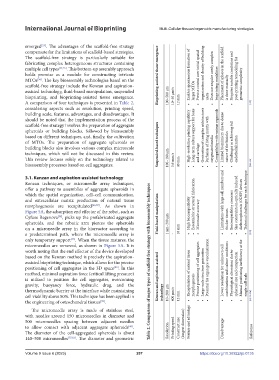
            A comparison of four techniques is presented in Table 2,          12 mm  •   •   •   •   •      [129]
            considering aspects such as resolution, printing speed,
            building scale, features, advantages, and disadvantages. It
            should be noted that the implementation process of the
            scaffold-free strategy involves the preparation of aggregate
            spheroids or building blocks, followed by bioassembly
            based on different techniques, and, finally, the cultivation          High-resolution printing capability Long-term culture support for bone   Generation of complex architectures Perfusion of living matrix with   Compatibility with various organoids Limited biomimicry due to dense
            of MTOs. The preparation of aggregate spheroids or      Suspended-based techniques      Challenges in achieving full
            building blocks also involves various complex microscale                        oxygenated media  nature of the bioinks  endothelialization
            techniques, which will not  be  discussed  in  this review.               and cartilage
            This review focuses solely on the technology related to      100–180 µm  5.6 mm/s
            bioassembly processes based on cell aggregates.                   40 mm  •   •   •   •   •   •   •   [126–128]

            3.1. Kenzan and aspiration-assisted technology
            Kenzan techniques, or microneedle array techniques,
            offer a pathway to assemblies of aggregate spheroids in
            which the spatial organization, cell–cell communication,
            and extracellular matrix production of natural tissue                               Limitations with large cell numbers and   Size constraints in optically induced   Technical challenges for each technique
            morphogenesis are recapitulated [43,57] . As shown in                   Essential for structural fabrication  dielectrophoresis (ODEP) devices
            Figure 5A, the adsorption end effector of the robot, such as          High biocompatibility  Biocompatibility concerns
            Cyfuse Regenova , picks up the prefabricated aggregate   Fluid-based manipulation  Microscale accuracy  thicker tissues
                          [58]
            spheroids, and the robotic arm pierces the spheroids         1 nm–300 µm
            on a microneedle array in the bioreactor according to             10 mm
            a predetermined path, where the microneedle array is           -      •   •   •     •   •   •   •   [125]
            only temporary support . When the tissue matures, the
                               [35]
            microneedles are removed, as shown in  Figure 5A. It is
            worth noting that the end effector of the device developed
            based on the Kenzan method is precisely the aspiration-
            assisted bioprinting technique, which allows for the precise  Table 2. Comparison of major types of scaffold-free strategy with bioassembly techniques
            positioning of cell aggregates in the 3D space . In this                  Precise positioning of cell aggregates  Potential for organ pre-vascularization  Lower resolution for unknown cell  combinations and culture conditions  Manual positioning inefficiency at the
                                                  [59]
            method, minimal aspiration force (critical lifting pressure)          Recapitulation of natural tissue   Large-scale structure generation  Physiological alterations due to  spheroid size and compaction
            is utilized to position the cell aggregates, overcoming   Kenzan and aspiration-assisted
            gravity, buoyancy force, hydraulic drag, and the                        morphogenesis         single-cell scale
            thermodynamic barrier at the interface while maintaining   technology  10–200 µm
            cell viability above 80%. This technique has been applied in   400 µm/s  12 mm                  [43,105,124]
            the engineering of osteochondral tissues .                            •   •   •   •   •   •   •
                                            [59]
               The microneedle array is made of stainless steel,
            with needles around 150 microneedles in diameter and
            500 microneedles spacing between adjacent needles                   (longest dimension)  Feature and advantage
            to allow contact with adjacent aggregate spheroids .           Printing speed  Construct size  Disadvantage
                                                        [60]
            The diameter of the cell-aggregated spheroids is about       Resolution                          Reference
            140–500 microneedles [57,61] . The diameter and geometric


            Volume 9 Issue 6 (2023)                        207                        https://doi.org/10.36922/ijb.0135

