


Page 214 - IJB-9-6
P. 214
International Journal of Bioprinting                     Multi-Cellular tissues/organoids manufacturing strategies


            photopolymerization of orderly extruded multi-materials
            (POEM) has been proposed, developed, and fully
            characterized , and a novel workflow utilizing machine
                       [44]
            learning to achieve precise control over the stiffness of
            elastomeric scaffolds enables the fabrication of multi-scale
            structures with MTOs applications . However, their
                                          [45]
            applications in bioprinting are limited due to the harmful
            effects of UV rays (resulting in more DNA damage with
            shorter wavelengths) and cytotoxic effects from increased
            light intensity and photoinitiator concentration. To
            mitigate DNA damage, the use of visible light sources and
            biocompatible photoinitiators is necessary. The drawbacks
            of VP-based bioprinting exceed its benefits. The inherent
            characteristics of this technique render it inappropriate
            for generating complete tissue constructs that meet the
            requirements of regenerative medicine . Nevertheless,
                                            [46]
            this  approach  can  be  employed  to  achieve  precise
            patterning  of  multi-cellular  microenvironments,  such  as
            the tumor microenvironment, for the purpose of disease
            modeling or drug testing .
                                [47]
               The scaffold is used to provide material support and a
            conducive cell growth environment for MTOs. An ideal
            scaffold should possess sufficient mechanical stability and
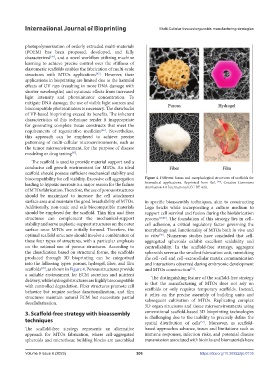
            biocompatibility for cell viability. Excessive cell aggregation   Figure 4. Different forms and morphological structures of scaffolds for
            leading to hypoxic necrosis is a major reason for the failure   biomedical applications. Reprinted from Ref.   [48] , Creative Commons
                                                               Attribution 4.0 International (CC BY 4.0).
            of MTOs fabrication. Therefore, the use of porous structures
            should be maximized to increase the cell attachment
            surface area and maintain the good breathability of MTOs.   in  specific  bioassembly  techniques,  akin to  constructing
            Additionally, non-toxic and safe biocompatible materials   Lego bricks while incorporating a culture medium to
            should be employed for the scaffold. Thin film and fiber   support cell survival and fusion during the biofabrication
            structures can  complement the mechanical-support   process [10,49] . The foundation of this strategy lies in cell–
            stability and serve as plastic-support structures on the outer   cell adhesion, a critical regulatory factor governing the
            surface once MTOs are initially formed. Therefore, the   morphology and functionality of MTOs both in vivo and
            optimal scaffold structure should involve a combination of   in vitro . Numerous studies have concluded that cell-
                                                                     [50]
            these four types of structures, with a particular emphasis   aggregated  spheroids  exhibit  excellent  scalability  and
            on the rational use of porous structures. According to   controllability. In the scaffold-free strategy, aggregate
            the classification based on structural forms, the scaffolds   spheroids serve as the smallest fabrication unit, mimicking
            produced through 3D bioprinting can be categorized   the cell–cell and cell–extracellular matrix communication
            into the following types: porous, hydrogel, fiber, and film   and interactions observed during embryonic development
            scaffolds , as shown in Figure 4. Porous structures provide   and MTOs construction .
                   [48]
                                                                                  [51]
            a suitable environment for ECM secretion and nutrient
            delivery, while hydrogel structures are highly biocompatible   The distinguishing feature of the scaffold-free strategy
            with controlled degradation. Fiber structures promote cell   is that the manufacturing of MTOs does not rely on
            behavior but require surface functionalization, and film   scaffolds or only requires temporary scaffolds. Instead,
            structures maintain natural ECM but necessitate partial   it relies on the precise assembly of building units and
            decellularization.                                 subsequent cultivation of MTOs. Replicating complex
                                                               3D organ structures and tissue microenvironments using
            3. Scaffold-free strategy with bioassembly         conventional scaffold-based 3D bioprinting technologies
            techniques                                         is challenging due to the inability to precisely define the
                                                               spatial distribution of cells . Moreover, as scaffold-
                                                                                      [52]
            The scaffold-free strategy represents an alternative   based approaches advance, issues and limitations such as
            approach for MTOs fabrication, where cell-aggregated   immune responses, infection risks, and potential disease
            spheroids and microtissue building blocks are assembled   transmission associated with bioinks and biomaterials have

            Volume 9 Issue 6 (2023)                        206                        https://doi.org/10.36922/ijb.0135

