


Page 209 - IJB-9-6
P. 209
International Journal of Bioprinting                     Multi-Cellular tissues/organoids manufacturing strategies


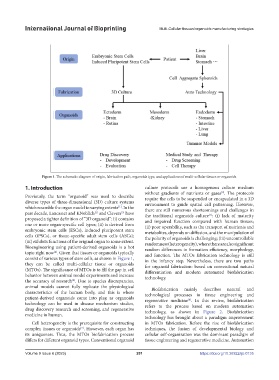
                   Figure 1. The schematic diagram of origin, fabrication path, organoids type, and applications of multi-cellular tissues or organoids.

            1. Introduction                                    culture protocols use a homogenous culture medium
                                                               without gradients of nutrients or gases . The protocols
                                                                                               [6]
            Previously, the term “organoid” was used to describe   require the cells to be suspended or encapsulated in a 3D
            diverse types of three-dimensional (3D) culture systems   environment to  guide  spatial  cell  patterning. However,
            which resemble the organ model to varying extents . In the   there are still numerous shortcomings and challenges in
                                                    [1]
            past decade, Lancaster and KNoblich  and Clevers  have   the traditional organoids culture : (i) lack of maturity
                                                     [3]
                                         [2]
                                                                                          [7]
            proposed a tighter definition of “3D organoid”: (i) contains   and  impaired  function compared  with  human tissues;
            one or more organ-specific cell types; (ii) is derived from   (ii) poor operability, such as the transport of nutrients and
            embryonic stem cells (ESCs), induced pluripotent stem   metabolites, depends on diffusion, and the manipulation of
            cells (iPSCs), or tissue-specific adult stem cells (ASCs);   the polarity of organoids is challenging; (iii) uncontrollable
            (iii) exhibits functions of the original organ to some extent.   randomness (heterogeneity), where there are also significant
            Bioengineering using patient-derived organoids is a hot   random differences in formation efficiency, morphology,
            topic right now . Given that tissues or organoids typically   and function. The MTOs fabrication technology is still
                        [4]
            consist of various types of stem cells, as shown in Figure 1,   in the infancy step. Nevertheless, there are two paths
            they  can  be  called  multi-cellular  tissue  or  organoids   for organoid fabrication: based on conventional natural
            (MTOs). The significance of MTOs is to fill the gap in cell   differentiation and modern automated biofabrication
            behavior between animal model experiments and increase   technology.
            the accuracy of research . Due to species discrepancies,
                                [4]
            animal models cannot fully replicate the physiological   Biofabrication  mainly  describes  natural  and
            characteristics  of  the  human  body,  and this  is  where   technological processes in tissue engineering and
            patient-derived organoids come into play, as organoids   regenerative medicine . In this review, biofabrication
                                                                                 [8]
            technology  can  be  used  in  disease  mechanism  studies,   refers to the  process based on modern automation
            drug discovery research and screening, and regenerative   technology, as shown in  Figure 2. Biofabrication
            medicine in human.
                                                               technology has brought about a paradigm improvement
               Cell heterogeneity is the prerequisite for constructing   in  MTOs  fabrication.  Before  the  rise  of  biofabrication
            complex tissues or organoids . However, each organ has   techniques, the fusion of developmental biology and
                                   [5]
            its uniqueness. Thus, the MTOs biofabrication process   cellular self-organization was the dominant paradigm of
            differs for different organoid types. Conventional organoid   tissue engineering and regenerative medicine. Automation

            Volume 9 Issue 6 (2023)                        201                        https://doi.org/10.36922/ijb.0135

