


Page 211 - IJB-9-6
P. 211
International Journal of Bioprinting                     Multi-Cellular tissues/organoids manufacturing strategies


            section, we compared the advantages, disadvantages, and
            applicability of scaffold-based and scaffold-free strategies.
            We believe that a balanced consideration of both approaches
            is necessary to achieve the common goal of manufacturing
            functional tissue-like structures (MTOs). Subsequently,
            we delved into the discussion of convergence strategies
            and hybrid biofabrication technologies. The vision for
            future  prospective  hybrid  technology  involves  emerging
            convergence strategies for fabricating complex MTOs.
            Subsequently, a novel MTOs biofabrication method based                  High resolution (lateral around 20–50 μm, vertical around 25–100 μm)  Faster printing speed and the ability to print large-scale structures with
            on the convergence strategy, the BioMicroMesh method                     Ability to print a wide range of viscosities of bioresin (up to 5 Pa·s) Potential to fabricate highly complex structures, support structure   Harmful effects of UV rays, resulting in more DNA damage Cytotoxic effects from increased light intensity and photoinitiator
            (BMMm), is introduced for the first time. Concurrently,                                 Material degradation and bubble damage in two-photon
            the development of new MTOs biofabrication equipment,
            the BioMicroMesh system (BMMs), is underway, aiming to
            provide precise experimental variable control and ensure                                  polymerization (2PP) technology
            the fabrication of commercial MTOs models for biological   Vat photopolymerization-based  Medium (200–1600 mm/s)  Chemical, photocrosslinking  fabrication possible  micron-level resolution
            research. It is hoped that this review will encourage further                         concentration
            research and development in MTOs manufacturing and           10–100 µm  >10 8  cells/ml
            related specialized equipment.                          No     >95%     •   •   •   •   •   •   •   [121,123]


            2. Scaffold-based strategy with
            3D bioprinting techniques

            Scaffold-based strategy is a pivotal approach in the
            fabrication of MTOs constructs, as scaffolds form
            the  fundamental  architecture of  such  constructs,  and
            3D  bioprinting technology  serves as  the  mainstream                   Wide range of printable biocompatible materials  High mechanical pressure and shear stress
            methodology for scaffold manufacturing [19,20] . Scaffolds play    Chemical, photocrosslinking, shear   dilution,   Printable high-viscosity biomaterials  Highly controlled printing structure
            a crucial role in providing structural support for cellular                           leading to reduced cell viability
            adhesion and subsequent MTOs maturation [21,22] . 3D                       Most commonly used  Limited resolution range
            bioprinting technology is an additive fabrication method   Extrusion-based  Slow (10–50 μm/s)
            that prints scaffolds layer-by-layer automatically. The      100–500 µm  10 8 –10 9  cells/ml  temperature
            technology has become a promising strategy in cell-laden   Exist  80%   •   •   •   •   •   •   [121,122]
            tissue engineering or MTOs restoration [12,23] . In a general
            sense, 3D bioprinting can be divided into four development
            stages . Stage I involves the printing of non-biocompatible
                [24]
            structures that can be used as models for surgery planning.
            Stage II encompasses the printing of biocompatible but
            non-biodegradable products, such as implanted prostheses.
            Stage III focuses on the printing of biocompatible and                   Requires the printed biomaterial to be in liquid   Cannot print high-viscosity materials or high
            biodegradable products that can serve as scaffolds to  Table 1. Comparison of major types of scaffold-based 3D bioprinting techniques  Can be equipped with multiple nozzles  The thermal actuator is potentially prone to  reduced equipment structural stability and   Printhead is prone to wear and clogging.
            enhance tissue damage repair or regeneration. Finally,
            Stage IV involves cellular printing to create biomimetic           Chemical, photocrosslinking  Complex nozzle structure  compromised cell viability.  concentrations of cells
            3D structures using cells . In this article, we provide a                      Easy accessibility  Low drive pressure
                                [24]
            comprehensive definition of bioprinting that encompasses   Jetting-based  Fast (1–10 4  drop/s)  10 6 –10 7  cells/ml
            the stages of development from Stage III to Stage IV. Based   Exist  50–100 µm  >85%  form     [118–120]
            on the different printing mechanisms, 3D bioprinting                    •   •   •   •   •   •   •   •
            technology can be categorized into three main types: jetting-
            based , extrusion-based , and vat photopolymerization-
                                [25]
                [20]
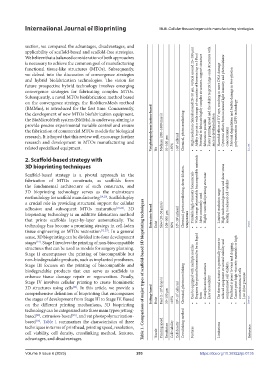
            based .  Table 1 summarizes the characteristics of three           Crosslinking method
                [26]
            techniques in terms of printhead, printing speed, resolution,   Printing speed  Cell viability
            cell viability, cell density, crosslinking method, features,   Nozzle  Resolution  Cell density  Features  Limitations  Reference
            advantages, and disadvantages.

            Volume 9 Issue 6 (2023)                        203                        https://doi.org/10.36922/ijb.0135

