


Page 216 - IJB-9-6
P. 216
International Journal of Bioprinting                     Multi-Cellular tissues/organoids manufacturing strategies


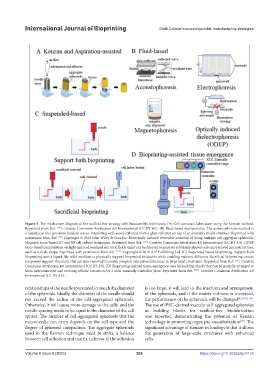
            Figure 5. The mechanism diagram of the scaffold-free strategy with bioassembly techniques. (A) Cell construct fabrication using the Kenzan method.
            Reprinted from Ref.   [113] , Creative Commons Attribution 4.0 International (CC BY 4.0). (B) Fluid-based manipulation. The acoustophoresis method is
            a transducer that generates incident waves, interfering with waves reflected from a glass reflector on top of an assembly media chamber. Reprinted with
            permission from Ref.   [77] . Copyright © 2016 John Wiley & Sons Inc. Electrically induced reversible assembly of living multiple cell aggregate spheroids.
            Magnetic force-based 2D and 3D cell culture techniques. Reprinted from Ref.  [114] . Creative Commons Attribution 4.0 International (CC BY 4.0). ODEP
            force-based manipulation via light-induced localized electrical fields. Light can be directed to generate arbitrarily shaped cell-encapsulated microstructures,
            such as a circle shape. Reprinted with permission from Ref.   [115] . Copyright © 2018 AIP Publishing Ltd. (C) Suspended-based bioprinting. Support bath
            bioprinting uses a liquid-like solid medium to physically support bioprinted structures while enabling nutrient diffusion. Sacrificial bioprinting creates
            temporary support structures that are later removed to enable complex internal architectures in bioprinted constructs. Reprinted from Ref.  [116] , Creative
            Commons Attribution 4.0 International (CC BY 4.0). (D) Bioprinting-assisted tissue emergence uses biobuilding blocks that can be spatially arranged to
            form interconnected and evolving cellular constructs by 3-axial manually controller plate. Reprinted from Ref.  [117] , Creative Commons Attribution 4.0
            International (CC BY 4.0).


            relationships of the needle space need to match the diameter   is too large, it will lead to the insertion and arrangement
            of the spheroids. Ideally, the diameter of the needle should   of the spheroids, and if the matrix richness is increased,
            not exceed the radius of the cell-aggregated spheroids.   the performance of the spheroids will be changed [43,57,62-64] .
            Otherwise, it will cause more damage to the cells, and the   The use of iPSC-derived vascular cell-aggregated spheroids
            needle spacing needs to be equal to the diameter of the cell   as building blocks for scaffold-free biofabrication
            sphere. The number of cell-aggregated spheroids that the   was  reported,  demonstrating  the potential  of  Kenzan
            microneedle can carry depends on the cell type and the   technology in promoting organ pre-vascularization . The
                                                                                                        [29]
            degree of spheroid compaction. The aggregate spheroids   significant advantage of Kenzan technology is that it allows
            used in the Kenzan technique need to strike a balance   the generation of large-scale structures with enhanced
            between cell adhesion and matrix richness. If the adhesion   cells.


            Volume 9 Issue 6 (2023)                        208                        https://doi.org/10.36922/ijb.0135

