


Page 219 - IJB-9-6
P. 219
International Journal of Bioprinting                     Multi-Cellular tissues/organoids manufacturing strategies


            manufacturing structurally  complex and  mechanically
            robust MTOs, while scaffold-free strategies are more
            suitable for creating biologically scalable constructs that
            better mimic native tissue environments. The integration of
            both approaches enables the utilization of their respective
            strengths and the mitigation of their limitations, thereby
            advancing the development of functional multi-cellular
            tissues and organoids.
               Scaffold-based and scaffold-free strategies are employed
            for manufacturing  MTOs. Scaffold-based strategies                   bioprocessing, and automation, achieve a balance between scale, biosafety,  printing or self-assembly of tissues and organ samples with high accuracy   The printing speed of current devices limits the practical application of fusion
            involve using scaffold structures as physical support              Integrated biomanufacturing technologies, including 3D bioprinting,  Automated biomanufacturing technologies improve and accelerate the  The integration of melt electrospinning writing technology and extrusion  bioprinting technology creates stable, high-strength, and large-scale lay- strategies, and slow printing speed is an obstacle that needs to be addressed. The process of achieving complex
            for  guiding  cell  growth  and  organization,  providing                          ered structures with spatial distribution of different cell types.
            structural integrity, and facilitating the formation of
            MTOs architectures. Biocompatible materials are crucial
            for scaffold manufacturing to support cell viability .
                                                        [90]
            While 3D bioprinting offers precise fabrication of complex
            scaffold structures and allows for co-printing multiple cell
            types and biomaterials, it also has limitations . The limited          and resolution.  and throughput.  multiple cell types.
                                               [91]
            availability and performance of biocompatible materials   Convergence
            and bioinks pose challenges related to ink contamination   Good  Good  Good  Good
            and toxicity . Furthermore, 3D bioprinting is relatively           •     •     •      •   •     [89]
                     [92]
            slow and can encounter issues like nozzle clogging and
            large equipment size due to the complexity of the printing
            apparatus .
                    [93]
               On the other hand, scaffold-free strategies aim to create
            MTOs without using exogenous scaffolds. These strategies             Simplifies manufacturing process Reduces risk of immune response  Difficulty in controlling cell distri-
            rely on the inherent self-assembly and organization abilities      Closer to natural environment  Tissue morphology instability  Lack of mechanical support
            of cells to form functional tissues. Cells are cultured and
            allowed to aggregate or undergo spheroid formation,
            promoting cell–cell interactions and extracellular matrix   Scaffold-free                 bution
            deposition . Scaffold-free approaches offer advantages    Bad  Good  Bad  Good  •   •   •   •   •   •   [113]
                    [94]
            such as simplified fabrication processes, enhanced cell–cell
            communication, and the potential to recapitulate native
            tissue organization . The advantages of scaffold-free
                            [95]
            strategies directly address the drawbacks of scaffold-based
            strategies. However, they often face challenges in achieving       Provides mechanical support  Requires additional steps and
            precise control over MTOs architecture and may have                  Controls cell distribution  Promotes vascularization  Potential immune response  May affect cell functionality
            limited scalability .
                          [96]
               The  choice  between  scaffold-based  and  scaffold- Table 3. Comparison of scaffold-based, scaffold-free, and convergence strategy  Scaffold-based  materials
            free  strategies depends on the specific requirements     Good  Bad  Good  Bad  •   •   •   •   •   •   [130]
            of the desired MTOs. Scaffold-based approaches are
            advantageous for fabricating complex and anatomically
            accurate structures, providing mechanical support, and
            enabling the incorporation of multiple cell types. In
            contrast, scaffold-free strategies offer simplicity, better
            mimicry of native tissue microenvironments, and potential        Functionalization with biomolecules
            scalability for high-throughput applications. Ultimately,      Possibility of tissue self-assembly
            a combination of both strategies may be employed            Mechanical properties
            to harness their respective strengths and overcome        Initial cell density        Disadvantages
            limitations, advancing the development of functional               Advantages                    Reference
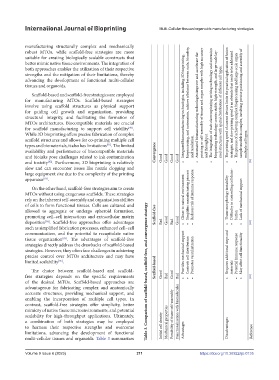
            multi-cellular tissues and organoids. Table 3 summarizes


            Volume 9 Issue 6 (2023)                        211                        https://doi.org/10.36922/ijb.0135

