


Page 257 - IJB-9-6
P. 257
International Journal of Bioprinting                           3D-Printed GelMA biomaterials in cartilage repair


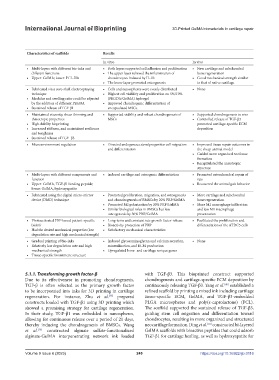
 Table 2. Summary of 3D-printed GELMA scaffolds loaded with growth factors in articular cartilage repair
 Scaffolds  Bioinks  Growth factor   Role of growth factors  Characteristics of scaffolds  Results
 loaded
                                             In vitro                              In vivo
 IL-4-loaded bi-layer scaffolds [44]  GelMA, PCL-HA  IL-4  Anti-inflammation  •  Multi-layers with different bio-inks and   •  Both layers supported cell adhesion and proliferation  •  New cartilage and subchondral
               different functions           •  The upper layer relieved the inflammation of   bone regeneration
             •  Upper: GelMA; lower: PCL-HA    chondrocytes induced by IL-1b       •  Good mechanical strength similar
                                             •  The lower layer promoted osteogenesis  to that of native cartilage
 Cell-laden bioprinted cartilage   GelMA, PEGDA, photoinitiator, and   TGF-β1  Induce cells toward chondrogenesis  •  Fabricated via a core-shell electrospraying   •  Cells and nanospheres were evenly distributed  •  None
 construct [38]  TGF-β1-embedded nanospheres  technique  •  Highest cell viability and proliferation on 5%/10%
             •  Modulus and swelling ratio could be adjusted   (PEGDA/GelMA) hydrogel
               by the addition of different PEGDA  •  Improved chondrogenic differentiation of
             •  Sustained release of TGF-β1    encapsulated MSCs.
 Alginate-GelMA interpenetrating   Alginate sulfate, GelMA, and TGF-β3  TGF- β3  Induce cells toward chondrogenesis  •  Maintained viscosity, shear-thinning and   •  Supported viability and robust chondrogenesis of   •  Supported chondrogenesis in vivo
 network (IPN) constructs [39]  thixotropic properties  MSCs                       •  Controlled release of TGF-β3
             •  High-fidelity bioprinting                                            promoted cartilage-specific ECM
             •  Increased stiffness, and maintained resilience                       deposition
               and toughness
             •  Sustained release of TGF- β3
 Microenvironmentally optimized   A 3D printing ink containing D-ECM,   TGF-β3  Induce cells toward chondrogenesis  •  Microenvironment regulation  •  Directed endogenous stem/progenitor cell migration   •  Improved tissue repair outcomes in
 3D-printed TGF-β-functionalized   GelMA, PLGA, and TGF-β3, and PCL  and differentiation  the sheep animal model
 scaffolds [40]                                                                    •  Guided more organized neotissue
                                                                                     formation
                                                                                   •  Recapitulated the anisotropic
                                                                                     structure
 3D-printed porous scaffolds of hydrogels  GelMA, hydroxyapatite, and TGF-β1-  TGF-β1-binding   Induce the endogenous TGF-β1   •  Multi-layers with different components and   •  Induced cartilage and osteogenic differentiation  •  Promoted osteochondral repair of
 modified with TGF-β1-binding   binding peptide  peptide  recruitment for chondrogenesis  function  rats
 peptides [41]  •  Upper: GelMA, TGF-β1 binding peptide;                           •  Recovered the animal gait behavior
               lower: GelMA, hydroxyapatite
 3D-printed PRP-GelMA hydrogels [49]  GelMA and PRP  PRP  Regulate the behaviors of BMSCs and   •  Fabricated using the digital micro-mirror   •  Promoted proliferation, migration, and osteogenesis   •  More cartilage and subchondral
 macrophage    device (DMD) technique          and chondrogenesis of BMSCs by 20% PRP/GelMA  bone regeneration
                                             •  Promoted M2 polarization by 20% PRP/GelMA  •  More M2 macrophage infiltration
                                             •  Similar biological roles in BMSCs but less   and less M1 macrophage
                                               osteogenesis by 50% PRP/GelMA         presentation
 3D-printed PRP-GelMA hydrogels [50]  GelMA and PRP  PRP  Regulate the behaviors of cells  •  Photoactivated PRP-based patient-specific   •  Long-term and constant rate growth factor release  •  Facilitated the proliferation and
               bioink                        •  Bioactivity protection of PRP        differentiation of the ATDC5 cells
             •  Had the desired mechanical properties (low   •  Satisfactory mechanical characteristics
               degradation rate and high mechanical strength)
 Osteochondral construct [51]  PRP, AdMSCs, and ECM mimetic   PRP  Regulate the differentiation of AdMSCs   •  Gradual printing of bio-inks  •  Induced glycosaminoglycan and calcium secretion,   •  None
 hydrogel, and GelMA  toward chondrocytes  •  Relatively low degradation rate and high   mineralization, and ECM production
               mechanical strength           •  Upregulated bone- and cartilage-unique genes
             •  Tissue-specific biomimetic structure


            5.1.1. Transforming growth factor-β                with  TGF-β3.  This  bioprinted  construct  supported
            Due to its effectiveness in promoting chondrogenesis,   chondrogenesis and cartilage-specific ECM deposition by
                                                                                                 [40]
            TGF-β is often selected as the primary growth factor   continuously releasing TGF-β3. Yang et al.  established a
            to be incorporated into inks for 3D printing in cartilage   refined scaffold by printing a mixed ink including cartilage
            regeneration. For instance, Zhu  et al.  prepared   tissue-specific ECM, GelMA, and TGF-β3-embedded
                                               [38]
            constructs loaded with TGF-β1 using 3D printing which   PLGA microspheres and poly(ε-caprolactone) (PCL).
            showed a promising strategy for cartilage regeneration.   The scaffold supported the sustained release of TGF-β3,
            In their study, TGF-β1 was embedded in nanospheres,   guiding stem cell migration and differentiation toward
            allowing for continuous release over a period of 21 days,   chondrocytes, resulting in more organized and structured
                                                                                         [41]
            thereby inducing the chondrogenesis of BMSCs. Wang    neocartilage formation. Ding et al.  constructed bi-layered
            et al.  constructed alginate sulfate-functionalized   GelMA scaffolds with bioactive peptides that could adsorb
                 [39]
            alginate-GelMA interpenetrating network ink loaded   TGF-β1 for cartilage healing, as well as hydroxyapatite for

            Volume 9 Issue 6 (2023)                        249                         https://doi.org/10.36922/ijb.0116

