


Page 270 - IJB-9-6
P. 270
International Journal of Bioprinting                                     3D bioprinting for vascular system


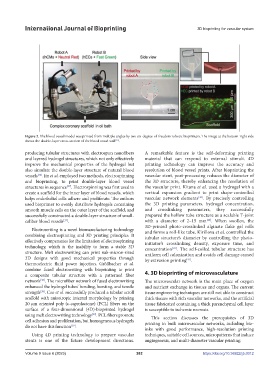
            Figure 2. The blood vessel model was printed from multiple angles by two six-degree-of-freedom robotic bioprinters. The image at the bottom-right side
            shows the double-layer cross-section of the blood vessel wall .
                                                  [35]
            producing tubular structures with electrospun nanofibers   A remarkable feature is the self-deforming printing
            and layered hydrogel structures, which not only effectively   material that can respond to external stimuli. 4D
            improve the mechanical properties of the hydrogel but   printing technology can improve the accuracy and
            also simulate the double-layer structure of natural blood   resolution of blood vessel prints. After bioprinting the
            vessels . Jin et al. employed two methods, electrospinning   vascular stent, post-processing reduces the diameter of
                 [36]
            and bioprinting, to print double-layer blood vessel   the 3D structure, thereby enhancing the resolution of
            structures in sequence . Electrospinning was first used to   the vascular print. Kitana et al. used a hydrogel with a
                              [37]
            create a scaffold for the inner layer of blood vessels, which   vertical expansion gradient to print shape-controlled
            helps endothelial cells adhere and proliferate. The authors   vascular  network elements [40] .  By precisely  controlling
            used bioprinter to evenly distribute hydrogels containing   the 3D printing parameters, hydrogel concentration,
            smooth muscle cells on the outer layer of the scaffold, and   and crosslinking parameters, they successfully
            successfully constructed a double-layer structure of small-  prepared the hollow tube structure as a scalable T-joint
            caliber blood vessels .                            with a diameter of 2–15 mm [40] . When swollen, the
                            [37]
                                                               3D-printed photo-crosslinked alginate flake gel rolls
               Electrowriting is a novel biomanufacturing technology
            combining electrospinning and 3D printing principles. It   and forms a roll-like tube. Kirillova et al. controlled the
                                                               tubular structure’s diameter by controlling the photo-
            effectively compensates for the limitation of electrospinning   initiator’s  crosslinking  density,  exposure  time,  and
            technology, which is the inability to form a stable 3D   concentration [41] . The self-coiled tubular structure has
            structure. Melt electrowriting can print sub-micron-sized   uniform cell colonization and avoids cell damage caused
            3D designs with good mechanical properties through   by extrusion printing [41] .
            thermoelectric fluid power injection. Größbacher  et al.
            combine fused electrowriting with bioprinting to print
            a composite tubular structure with a patterned fiber   4. 3D bioprinting of microvasculature
            network . The microfiber network of fused electrowriting   The microvascular network is the main place of oxygen
                  [38]
            enhanced the hydrogel tubes’ bending, bursting, and tensile   and nutrient exchange in tissues and organs. The current
                  [38]
            strength . Cao et al. successfully produced a tubular scroll   tissue engineering techniques are still not able to construct
            scaffold with anisotropic internal morphology by printing   thick tissues with rich vascular networks, and the artificial
            20 μm oriented poly (ε-caprolactone) (PCL) fibers on the   tissue fabricated containing a thick parenchymal cell layer
            surface of a four-dimensional (4D)-bioprinted hydrogel   is susceptible to ischemic necrosis.
            using melt electrowriting technology . PCL fibers promote   This section discusses the prerequisites of 3D
                                        [39]
            cell adhesion and proliferation, but homogeneous hydrogels   printing in  built  microvascular networks,  including  bio-
            do not have this function .
                               [39]
                                                               inks with good performance, high-resolution printing
               Using 4D printing technology to prepare vascular   techniques, suitable cell sources, micropatterns that induce
            stents is one of the future development directions.   angiogenesis, and multi-diameter vascular printing.

            Volume 9 Issue 6 (2023)                        262                          https://doi.org/10.36922/ijb.0012

