


Page 275 - IJB-9-6
P. 275
International Journal of Bioprinting                                     3D bioprinting for vascular system


                                                                                               [69]
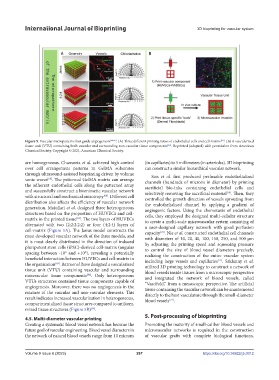
            Figure 5. Vascular micropatterns that guide angiogenesis [64,66] . (A) Three different printing ratios of endothelial cells and cell-matrix . (B) A vascularized
                                                                        [46]
            tissue unit (VTU) containing both vascular and surrounding non-vascular tissue components . Reprinted (adapted) with permission from American
            Chemical Society. Copyright © 2021, American Chemical Society.
            are homogeneous. Chansoria et al. achieved high control   (in capillaries) to 5 millimeters (in arterioles). 3D bioprinting
            over cell arrangement patterns in GelMA substrates   can construct a similar hierarchical vascular network.
            through ultrasound-assisted bioprinting driven by volume   Son  et al. first produced perfusable endothelialized
            sonic waves . The patterned GelMA matrix can arrange   channels (hundreds of microns in diameter) by printing
                     [68]
            the adherent endothelial cells along the patterned array   sacrificial bio-inks containing endothelial cells and
            and successfully construct a biomimetic vascular network   selectively removing the sacrificial material . Then, they
                                                                                                  [70]
            with structural and mechanical anisotropy . Different cell   controlled the growth direction of vessels sprouting from
                                             [68]
            distribution also affects the efficiency of vascular network   the endothelialized channel  by applying a gradient of
            generation. Maiullari et al. designed three heterogeneous   angiogenic factors. Using the chemotaxis of endothelial
            structures based on the proportion of HUVECs and cell-  cells, they employed the designed multi-cellular structure
            matrix in the printed tissue . The two layers of HUVECs   to create a multi-scale microvascular system consisting of
                                  [69]
            alternated with two (2:2:2:2:2) or four (4:2:4) layers of   a user-designed capillary network with good perfusion
            cell-matrix (Figure 5A). The Janus model constructs the   capacity . Nie et al. constructed endothelial cell channels
                                                                     [70]
            most developed vascular network of the three models, and   with diameters of 10, 20, 40, 100, 150, 250, and 500 μm
            it is most clearly distributed in the direction of induced   by adjusting the printing speed and squeezing pressure
            pluripotent stem cells (iPSC)-derived cell-matrix (angular   to control the size of blood vessel diameters precisely,
            spacing  between  -10°  and  +10°),  revealing  a  potentially   realizing the construction of the entire vascular system
            beneficial interaction between HUVECs and cell-matrix in   including large vessels and capillaries . Szklanny  et al.
                                                                                              [71]
            the organization . Barrs et al. have designed a vascularized   utilized 3D printing technology to construct a network of
                         [69]
            tissue unit (VTU) containing vascular and surrounding   blood vessels inside tissues from a microscopic perspective
            nonvascular tissue  components . Only  heterogeneous   and  integrated  the  network  of  blood  vessels,  called
                                      [46]
            VTUs structures contained tissue components capable of   “VascFold,” from a mesoscopic perspective. The artificial
            angiogenesis. Moreover, there was no angiogenesis in the   tissue containing the vascular network can be anastomosed
            mixture of the vascular and non-vascular elements. This   directly to the host vasculature through the small-diameter
            result indicates increased vascularization in heterogeneous,   blood vessels .
                                                                         [72]
            compartmentalized tissue structures compared to uniform,
            mixed tissue structures (Figure 5B) .
                                        [46]
                                                               5. Post-processing of bioprinting
            4.5. Multi-diameter vascular printing
            Creating a systematic blood vessel network has become the   Promoting the maturity of small-caliber blood vessels and
            future goal of vascular engineering. Blood vessel diameters in   microvascular networks is required in the construction
            the network of natural blood vessels range from 10 microns   of vascular grafts with complete biological functions.


            Volume 9 Issue 6 (2023)                        267                          https://doi.org/10.36922/ijb.0012

