


Page 319 - IJB-9-6
P. 319
International Journal of Bioprinting                              Rheology-informed machine learning model


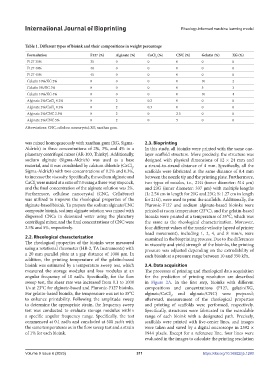
            Table 1. Different types of bioink and their compositions in weight percentage
             Formulation                F127 (%)  Alginate (%)  CaCl  (%)   CNC (%)    Gelatin (%)  XG (%)
                                                                   2
             F127 35%                   35        0             0           0          0            0
             F127 40%                   40        0             0           0          0            0
             F127 45%                   45        0             0           0          0            0
             Gelatin 10%/XG 2%          0         0             0           0          10           2
             Gelatin 5%/XG 3%           0         0             0           0          5            3
             Gelatin 10%/XG 4%          0         0             0           0          10           4
             Alginate 2%/CaCl  0.2%     0         2             0.2         0          0            0
                        2
             Alginate 2%/CaCl  0.3%     0         2             0.3         0          0            0
                        2
             Alginate 2%/CNC 2.5%       0         2             0           2.5        0            0
             Alginate 2%/CNC 5%         0         2             0           5          0            0
            Abbreviations: CNC, cellulose nanocrystal; XG, xanthan gum.


            was mixed homogeneously with xanthan gum (XG, Sigma-  2.3. Bioprinting
            Aldrich) in three concentrations of 2%, 3%, and 4% in a   In this study, all bioinks were printed with the same one-
            planetary centrifugal mixer (AR-100, Thinky). Additionally,   layer scaffold structure. More precisely, the structure was
            sodium alginate (Sigma-Aldrich) was used as a base   designed with physical dimensions of 12 × 24 mm and
            material, and it was crosslinked by calcium chloride (CaCl ,   a strand-to-strand distance of 4 mm. Specifically, all the
                                                         2
            Sigma-Aldrich) with two concentrations of 0.2% and 0.3%,   scaffolds were fabricated at the same distance of 0.4 mm
            to increase the viscosity. Specifically, the sodium alginate and   between the nozzle tip and the printing plate. Furthermore,
            CaCl  were mixed at a ratio of 7:3 using a three-way stopcock,   two types of nozzles, i.e., 21G (inner diameter: 514 μm)
                2
            and the final concentration of the alginate solution was 2%.   and 23G (inner diameter: 337 μm) with multiple lengths
            Furthermore, cellulose nanocrystal (CNC, CelluForce)   (L: 2.54 cm in length for 21G and 23G; S: 1.27 cm in length
            was utilized to improve the rheological properties of the   for 21G), were used to print the scaffolds. Additionally, the
            alginate-based bioink. To prepare the sodium alginate/CNC   Pluronic-F127 and sodium alginate-based bioinks were
            composite bioink, sodium alginate solution was mixed with   printed at room temperature (23°C), and the gelatin-based
            dispersed  CNCs  in  deionized  water  using  the  planetary   bioinks were printed at a temperature of 35°C, which was
            centrifugal mixer, and the final concentrations of CNC were   the same as the rheological characterization. Moreover,
            2.5% and 5%, respectively.                         four different values of the nozzle velocity (speed of printer
                                                               head movement), including 1, 2, 4, and 8 mm/s, were
            2.2. Rheological characterization                  examined in the bioprinting process. Due to the differences
            The rheological properties of the bioinks were measured   in viscosity and yield strength of the bioinks, the printing
            using a rotational rheometer (HR-2, TA Instruments) with   pressure was adjusted depending on the extrudability of
            a 20 mm parallel plate at a gap distance of 1000 μm. In   each bioink at a pressure range between 10 and 350 kPa.
            addition, the printing temperature of the gelatin-based
            bioink was estimated by a temperature sweep test, which   2.4. Data acquisition
            measured the storage modulus and loss modulus at an   The processes of printing and rheological data acquisition
            angular frequency of 10 rad/s. Specifically, for the flow   for the prediction of printing resolution are described
            sweep test, the shear rate was increased from 0.1 to 1000   in  Figure 2A. In the first step, bioinks with different
            1/s at 23°C for alginate-based and Pluronic-F127 bioinks.   compositions and concentrations (F127, gelatin/XG,
            For gelatin-based bioinks, the temperature was set to 35°C   alginate/CaCl , and alginate/CNC) were prepared;
                                                                          2
            to enhance printability. Following the amplitude sweep   afterward, measurement of the rheological properties
            to determine the appropriate strain, the frequency sweep   and printing of scaffolds were performed, respectively.
            test was conducted to evaluate storage modulus within   Specifically, structures were fabricated in the extrudable
            a specific angular frequency range. Specifically, the test   range of each bioink with a designated path. Precisely,
            commenced at 0.1 rad/s and concluded at 500 rad/s with   scaffolds were printed with five-center lines, and images
            the same temperatures as in the flow sweep test and a strain   were taken and saved by a digital microscope in 2592 ×
            of 1% for each bioink.                             1944 pixels. Except for a reference line, four lines were
                                                               evaluated in the images to calculate the printing resolution


            Volume 9 Issue 6 (2023)                        311                          https://doi.org/10.36922/ijb.1280

