


Page 318 - IJB-9-6
P. 318
International Journal of Bioprinting                              Rheology-informed machine learning model


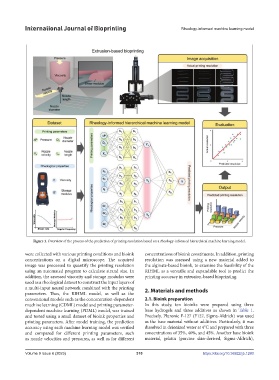
               Figure 1. Overview of the process of the prediction of printing resolution based on a rheology-informed hierarchical machine learning model.


            were collected with various printing conditions and bioink   concentrations of bioink constituents. In addition, printing
            concentrations on a digital microscope. The acquired   resolution was assessed using a new material added to
            image was processed to quantify the printing resolution   the alginate-based bioink, to examine the feasibility of the
            using an automated program to calculate strand size. In   RIHML as a versatile and expandable tool to predict the
            addition, the assessed viscosity and storage modulus were   printing accuracy in extrusion-based bioprinting.
            used as a rheological dataset to construct the input layers of
            a multi-input neural network combined with the printing   2. Materials and methods
            parameters. Thus, the RIHML model, as well as the
            conventional models such as the concentration-dependent   2.1. Bioink preparation
            machine learning (CDML) model and printing parameter-  In this study, ten bioinks were prepared using three
            dependent machine learning (PDML) model, was trained   base hydrogels and three additives as shown in  Table  1.
            and tested using a small dataset of bioink properties and   Precisely, Pluronic F-127 (F127, Sigma-Aldrich) was used
            printing parameters. After model training, the prediction   as the base material without additives. Particularly, it was
            accuracy using each machine learning model was verified   dissolved in deionized water at 4°C and prepared with three
            and compared for different printing parameters, such   concentrations of 35%, 40%, and 45%. Another base bioink
            as nozzle velocities and pressures, as well as for different   material, gelatin  (porcine skin-derived,  Sigma-Aldrich),


            Volume 9 Issue 6 (2023)                        310                          https://doi.org/10.36922/ijb.1280

