


Page 322 - IJB-9-6
P. 322
International Journal of Bioprinting                              Rheology-informed machine learning model


            and test set split by the ratio of 6:2:2 were performed with   where AR is the actual printing resolution and PR is the
            an applied random seed and fixed to all the models to avoid   predicted printing resolution. This represents the difference
            overfitting and estimate learning performance. To assess   between the actual and predicted value. Moreover, four
            the performance of learning, mean squared error (MSE)   different nozzle velocities and five unequal pressure values
            was used for loss estimation.                      were used as the variables of the printing parameters to
               Specifically, two classical machine learning algorithms,   predict the  printing resolution with  two  conventional
            RF and SVM, were prepared based on conventional    machine learning models and the RIHML. Specifically,
            regression models using ensembles of multiple decision   the printing resolution was predicted by different material
            trees and hyperplanes with maximum margin, respectively.   concentrations of bioinks with a split dataset via CDML
            Moreover, the two conventional machine learning models   and RIHML. Additionally, a new composition, alginate/
            consisted of an input layer, hidden layers, and an output   CNC composite bioink, was used to investigate the
            layer as shown in  Figure 3A and  B. Specifically, the   possibility of predicting the novel materials not considered
            printing parameter-dependent machine learning model   in the training set with CDML and RIHML. In the case
            uses only printing parameters, such as printing pressure,   of  CDML,  the  number  of  input layer  neurons  correlate
            nozzle velocity, nozzle diameter, and nozzle length.   with the number of materials. It means that by adding
            Besides, the concentration-dependent machine learning   a new material, parameters of the new material, such as
            model was incorporated into the input layer consisting of   concentration, should be included in the input layer, thus
            the  printing  parameters  and  the  concentrations  of  each   increasing the neurons. To follow the previous structure,
            bioink material.                                   the neuron of the CNC existed in the input layer of CDML.
                                                                  In  addition,  to provide a  visual  representation,
               Additionally, the RIHML was used with a multi-
            input layer model consisting of three input layers with   binary images of the printed scaffolds were created using
                                                               simulation. To generate the binary image, the printing
            hidden layers, concatenated layer, and its hidden layer;   strand size obtained from the machine learning model
            and an output layer shown in Figure 3C. The rheological   was converted into pixels. Using the converted strand size,
            properties, such as the viscosity and storage modulus,   the single-pixel lines representing the actual printing path
            were used as the first and second input layers of the   were dilated considering printing directions and angles.
            RIHML, respectively; and the last input layer consisted of   Afterward, the resulting binary values were converted
            the printing parameters. The hidden layers of each input   to the binary image to accurately simulate the printed
            layer were calculated separately and concatenated with the   scaffolds based on the predicted printing strand size.
            output layer. The final output was derived with a second
            hidden layer whose input is the concatenated output of the   3. Results
            first hidden layer.
                                                               3.1. Rheological properties of hydrogels
            2.6. Prediction of the printing resolution         In this study, the viscoelastic properties including viscosity
            The machine learning models predicted the printing   and storage modulus were assessed and implemented into
            resolution  with  different  cases  involving  new  printing   a rheological dataset of the bioinks. As shown in Figure 4A,
            parameters, different concentrations, and different bioink   the viscosity for ten bioinks was prepared to compare the
            compositions. More particularly, a dataset was created by   viscoelastic properties. Specifically, the shear-thinning
            multiple compositions of F127, gelatin/XG, and alginate/  behavior was observed in the flow curves of all bioinks,
            CaCl . Splitting was employed to train the model, except   and the F127-based bioinks exhibited the highest viscosity
                2
            for the variable required to perform the prediction in the   compared to  other  bioinks. The flow  curves of gelatin-
            pre-training stage. Specifically, the independent datasets   and alginate-based bioinks are relatively low and partially
            in the pre-training stage were provided for each machine   overlapped while increasing shear rates. Consequently, the
            learning model. They were divided into three parts   viscosities for various bioinks were compared with each
            (training set, validation set, and testing set) to train the   other at the shear rate of 100 1/s as shown in Figure 4B.
            model and estimate learning performance. The trained   The storage modulus was also measured to investigate the
            models have predicted printing resolution with a dataset   mechanical strength of the bioinks (Figure 4C and  D).
            consisting of excluded variables in the training dataset. The   Similar to the viscosity assessment, the highest shear moduli
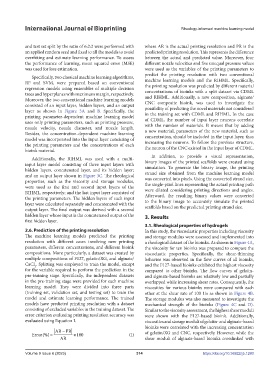
            error criterion evaluating printing resolution accuracy was   were shown with the F127-based bioink. Additionally,
            evaluated using Equation I.                        viscosities and storage moduli of gelatin- and alginate-based
                                                               bioinks were correlated with the increasing concentration
                         AR PR−                                of gelatin/XG and CNC, respectively. However, while the
               Error%() =       ×100                    (I)
                           AR                                  shear moduli of alginate-based bioinks crosslinked with


            Volume 9 Issue 6 (2023)                        314                          https://doi.org/10.36922/ijb.1280

