


Page 323 - IJB-9-6
P. 323
International Journal of Bioprinting                              Rheology-informed machine learning model


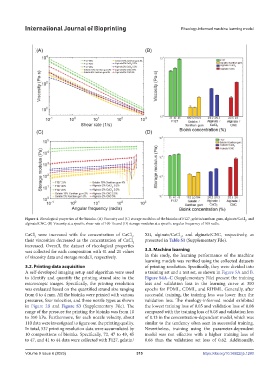
            Figure 4. Rheological properties of the bioinks. (A) Viscosity and (C) storage modulus of the bioinks of F127, gelatin/xanthan gum, alginate/CaCl , and
                                                                                                          2
            alginate/CNC. (B) Viscosity at a specific shear rate of 100 1/s and (D) storage modulus at a specific angular frequency of 100 rad/s.

            CaCl  were increased with the concentration of CaCl ,   XG, alginate/CaCl , and alginate/CNC, respectively, as
                                                         2
                2
                                                                              2
            their viscosities decreased as the concentration of CaCl    presented in Table S1 (Supplementary File).
                                                          2
            increased. Overall, the dataset of rheological properties
            was collected for each composition with 41 and 21 values   3.3. Machine learning
            of viscosity data and storage moduli, respectively.  In this study, the learning performance of the machine
                                                               learning models was verified using the collected datasets
            3.2. Printing data acquisition                     of printing resolution. Specifically, they were divided into
            A self-developed imaging setup and algorithm were used   a training set and a test set, as shown in Figure 5A and B.
            to identify and quantify the printing strand size in the   Figure S4A–C (Supplementary File) present the training
            microscopic images. Specifically, the printing resolution   loss and validation loss in the learning curve at 300
            was evaluated based on the quantified strand size ranging   epochs for PDML, CDML, and RIHML. Generally, after
            from 0 to 4 mm. All the bioinks were printed with various   successful  training,  the  training loss  was  lower  than  the
            pressures, four velocities, and three nozzle types as shown   validation loss. The rheology-informed model exhibited
            in  Figure 2B and  Figure S3 (Supplementary File). The   the lowest training loss of 0.05 and validation loss of 0.08
            range of the pressure for printing the bioinks was from 10   compared with the training loss of 0.08 and validation loss
            to 350 kPa. Furthermore, for each nozzle velocity, about   of 0.13 in the concentration-dependent model, which was
            110 data were investigated to figure out the printing quality.   similar to the tendency often seen in successful training.
            In total, 537 printing resolution data were accumulated by   Nevertheless, training using the parameter-dependent
            10 compositions of bioinks. Specifically, 72, 47 to 49, 45   model was not effective with a higher training loss of
            to 47, and 41 to 44 data were collected with F127, gelatin/  0.68 than the validation set loss of 0.62. Additionally,

            Volume 9 Issue 6 (2023)                        315                          https://doi.org/10.36922/ijb.1280

