


Page 325 - IJB-9-6
P. 325
International Journal of Bioprinting                              Rheology-informed machine learning model


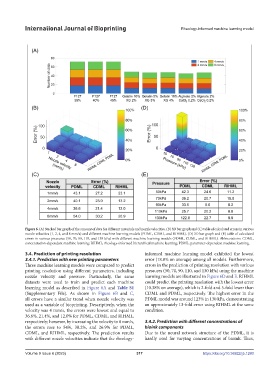
            Figure 6. (A) Stacked bar graph of the amount of data for different materials and nozzle velocities. (B) 3D bar graph and (C) table of calculated errors in various
            nozzle velocities (1, 2, 4, and 8 mm/s) and different machine learning models (PDML, CDML, and RIHML). (D) 3D bar graph and (E) table of calculated
            errors in various pressures (50, 70, 90, 110, and 130 kPa) with different machine learning models (PDML, CDML, and RIHML). Abbreviations: CDML,
            concentration-dependent machine learning; RIHML, rheology-informed hierarchical machine learning; PDML, parameter-dependent machine learning.

            3.4. Prediction of printing resolution             informed machine learning model exhibited the lowest
            3.4.1. Prediction with new printing parameters     error (18.8% on average) among all models. Furthermore,
            Three machine learning models were compared to predict   errors in the prediction of printing resolution with various
            printing resolution using different parameters, including   pressures (50, 70, 90, 110, and 130 kPa) using the machine
            nozzle  velocity and  pressure.  Particularly, the  same   learning models are illustrated in Figure 6D and E. RIHML
            datasets were used to train and predict each machine   could predict the printing resolution with the lowest error
            learning model as described in Figure 6A and Table S1   (10.38% on average), which is 2-fold and 5-fold lower than
            (Supplementary File). As shown in  Figure 6B and  C,   CDML and PDML, respectively. The highest error in the
            all errors have a similar trend when nozzle velocity was   PDML model was around 123% in 130 kPa, demonstrating
            used as a variable of bioprinting. Descriptively, when the   an approximately 13-fold error using RIHML at the same
            velocity was 4 mm/s, the errors were lowest and equal to   condition.
            36.6%, 21.4%, and 12.0% for PDML, CDML, and RIHML,
            respectively; however, by increasing the velocity to 8 mm/s,   3.4.2. Prediction with different concentrations of
            the errors rose to 54%, 30.2%, and 26.9% for PDML,   bioink components
            CDML, and RIHML, respectively. The prediction results   Due to the neural network structure of the PDML, it is
            with different nozzle velocities indicate that the rheology-  hardly used for varying concentrations of bioink. Thus,


            Volume 9 Issue 6 (2023)                        317                          https://doi.org/10.36922/ijb.1280

