


Page 327 - IJB-9-6
P. 327
International Journal of Bioprinting                              Rheology-informed machine learning model


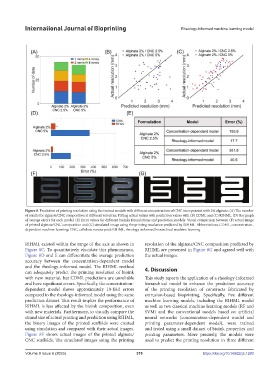
            Figure 8. Prediction of printing resolution using the trained models with different concentrations of CNC incorporated with 2% alginate. (A) The number
            of results for alginate/CNC composition at different velocities. Fitting actual values with prediction values with (B) CDML and (C) RIHML. (D) Bar graph
            of average errors for each model. (E) Error values for different bioinks formulations and prediction models. Visual comparison between (F) actual image
            of printed alginate/CNC composition and (G) simulated image using the printing resolution predicted by RIHML. Abbreviations: CDML, concentration-
            dependent machine learning; CNC, cellulose nanocrystal; RIHML, rheology-informed hierarchical machine learning.


            RIHML existed within the range of the axis as shown in   resolution of the alginate/CNC composition predicted by
            Figure 8C. To quantitatively elucidate this phenomenon,   RIHML are presented in Figure 8G and agreed well with
            Figure 8D and E can differentiate the average prediction   the actual images.
            accuracy between the concentration-dependent model
            and the rheology-informed model. The RIHML method   4. Discussion
            can adequately predict the printing resolution of bioink
            with new material, but CDML predictions are unreliable   This study reports the application of a rheology-informed
            and have significant errors. Specifically, the concentration-  hierarchical model to enhance the prediction accuracy
            dependent model shows approximately 10-fold errors   of the printing resolution of constructs fabricated by
            compared to the rheology-informed model using the same   extrusion-based bioprinting. Specifically, five different
            prediction dataset. This result implies the performance of   machine  learning  models,  including  the  RIHML  model
            RIHML is less affected by the bioink composition, even   as well as two classical machine learning models (RF and
            with new materials. Furthermore, to visually compare the   SVM)  and  the  conventional  models  based  on  artificial
            strand size of actual printing and prediction using RIHML,   neural networks (concentration-dependent model and
            the  binary  images  of  the  printed scaffolds were  created   printing parameter-dependent model), were trained
            using simulation and compared with their actual images.   and tested using a small dataset of bioink properties and
            Figure 8F shows actual images of the printed alginate/  printing parameters. More precisely, the models were
            CNC scaffolds. The simulated images using the printing   used to predict the printing resolution in three different

            Volume 9 Issue 6 (2023)                        319                          https://doi.org/10.36922/ijb.1280

