


Page 326 - IJB-9-6
P. 326
International Journal of Bioprinting                              Rheology-informed machine learning model


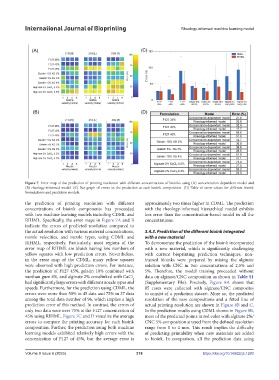
            Figure 7. Error map of the prediction of printing resolution with different concentrations of bioinks using (A) concentration-dependent model and
            (B) rheology-informed model. (C) Bar graph of errors in the prediction at each bioink composition. (D) Table of error values for different bioink
            formulations and prediction models.

            the  prediction of  printing resolution with  different   approximately two times higher in CDML. The prediction
            concentrations of bioink components has proceeded   with the rheology-informed hierarchical model exhibits
            with two machine learning models including CDML and   less error than the concentration-based model in all the
            RIHML. Specifically, the error maps in Figure 7A and B   concentrations.
            indicate the errors of predicted resolution compared to
            the actual resolution with various material concentrations,   3.4.3. Prediction of the different bioink integrated
            nozzle  velocities,  and  nozzle  types,  using  CDML  and   with a new material
            RIHML, respectively. Particularly, most regions of the   To demonstrate the prediction of the bioink incorporated
            error map of RIHML are bluish having low numbers of   with a new material, which is significantly challenging
            yellow  squares  with low prediction errors. Nevertheless,   with  current  bioprinting  prediction  techniques,  non-
            in the error map of the CDML, many yellow squares   trained bioinks were prepared by mixing the alginate
            were observed with high prediction errors. For instance,   solution with CNC in two concentrations of 2.5% and
            the prediction of F127 45%, gelatin 10% combined with   5%. Therefore, the model training proceeded without
            xanthan gum 4%, and alginate 2% crosslinked with CaCl    data on alginate/CNC composition as shown in Table S1
                                                          2
            had significantly large errors with different nozzle types and   (Supplementary File). Precisely,  Figure 8A shows that
            speeds. Furthermore, for the prediction using CDML, the   85 cases were collected with alginate/CNC composites
            errors were more than 50% in 45 data and 75% in 27 data   to consist of a prediction dataset. More so, the predicted
            among the total data number of 96, which implies a high   resolution of the new compositions and a fitted line of
            prediction error of this method. In contrast, the errors of   actual printing resolution are shown in Figure 8B and C.
            only two data were over 75% at the F127 concentration of   In the prediction results using CDML shown in Figure 8B,
            45% using RIHML. Figure 7C and D visualize the average   most of the predicted points in red color with alginate 2%/
            errors to compare the printing accuracy for each bioink   CNC 5% composition strayed from the defined resolution
            composition. Further, the prediction using both machine   range from 0 to 4 mm. This result implies the difficulty
            learning models exhibited relatively high errors with the   of predicting printability when new materials are added
            concentration of F127 of 45%, but the average error is   to bioink. In comparison, all the prediction data using


            Volume 9 Issue 6 (2023)                        318                          https://doi.org/10.36922/ijb.1280

