


Page 337 - IJB-9-6
P. 337
International Journal of Bioprinting                                   3D printing and bioprinting in urology


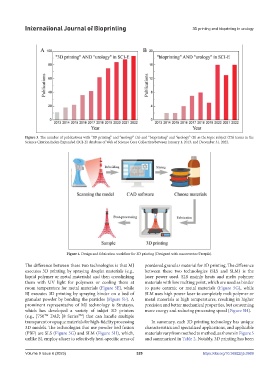
            Figure 3. The number of publications with “3D printing” and “urology” (A) and “bioprinting” and “urology” (B) as the topic subject (TS) terms in the
            Science Citation Index-Expanded (SCI-E) database of Web of Science Core Collection between January 1, 2013, and December 31, 2022.


                             Figure 4. Design and fabrication workflow for 3D printing (Designed with macrovector/Freepik).

            The difference between these two technologies is that MJ   powdered granular material for 3D printing. The difference
            executes 3D printing by spraying droplet materials (e.g.,   between these two technologies (SLS  and SLM) is the
            liquid polymer or metal materials) and then crosslinking   laser power used. SLS mainly heats and melts polymer
            them with UV light for polymers or cooling them at   materials with low melting point, which are used as binder
            room temperature for metal materials (Figure 5E), while   to paste ceramic or metal materials (Figure 5G), while
            BJ executes 3D printing by spraying binder on a bed of   SLM uses high power laser to completely melt polymer or
            granular powder by bonding the particles (Figure 5F). A   metal materials at high temperatures, resulting in higher
            prominent representative of MJ technology is Stratasys,   precision and better mechanical properties, but consuming
            which  has  developed  a  variety  of  inkjet  3D  printers   more energy and reducing processing speed (Figure 5H).
            (e.g., J750  DAP, J8 Series ) that can handle multiple
                                   TM
                    TM
            transparent or opaque materials for high-fidelity processing   In summary, each 3D printing technology has unique
            3D models. The technologies that use powder bed fusion   characteristics and specialized applications, and applicable
            (PBF) are SLS (Figure 5G) and SLM (Figure 5H), which,   materials vary from method to method, as shown in Figure 5
            unlike BJ, employ a laser to selectively heat-specific areas of   and summarized in Table 2. Notably, 3D printing has been


            Volume 9 Issue 6 (2023)                        329                          https://doi.org/10.36922/ijb.0969

