


Page 338 - IJB-9-6
P. 338
International Journal of Bioprinting                                   3D printing and bioprinting in urology


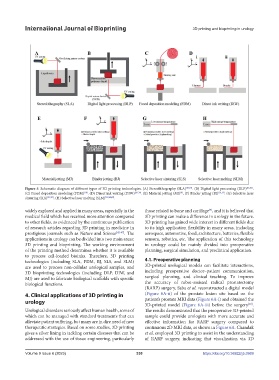
            Figure 5. Schematic diagram of different types of 3D printing technologies. (A) Stereolithography (SLA) [83,84] . (B) Digital light processing (DLP) [85,86] .
            (C) Fused deposition modeling (FDM) . (D) Direct ink writing (DIW) [28-30] . (E) Material jetting (MJ) . (F) Binder jetting (BJ) [34,35] . (G) Selective laser
                                                                              [8]
                                     [10]
            sintering (SLS) [37,87] . (H) Selective laser melting (SLM) [38,88,89] .
            widely explored and applied in many areas, especially in the   those related to bone and cartilage , and it is believed that
                                                                                          [9]
            medical field which has received more attention compared   3D printing can make a difference in urology in the future.
            to other fields, as evidenced by the continuous publication   3D printing has gained wide interest in different fields due
            of research articles regarding 3D printing in medicine in   to its high application flexibility in many areas, including
            prestigious journals such as Nature and Science [42-47] . The   aerospace, automotive, food, architecture, batteries, flexible
            applications in urology can be divided into two main areas:   sensors, robotics, etc. The application of this technology
            3D printing and bioprinting. The working environment   in urology could be mainly divided into preoperative
            of the printing method determines whether it is available   planning, surgical simulation, and preclinical application.
            to process cell-loaded bioinks. Therefore, 3D printing
            technologies (including SLA, FDM, BJ, SLS, and SLM)   4.1. Preoperative planning
            are used to process non-cellular urological samples, and   3D-printed urological models can facilitate interactions,
            3D bioprinting technologies (including DLP, DIW, and   including preoperative doctor–patient communication,
            MJ) are used to fabricate biological scaffolds with specific   surgical planning, and clinical teaching. To improve
            biological functions.                              the accuracy of robot-assisted radical prostatectomy
                                                               (RARP) surgery, Saba et al. reconstructed a digital model
            4. Clinical applications of 3D printing in         (Figure  6A-ii) of the prostate lesion site based on the
            urology                                            patient’s prostate MRI data (Figure 6A-i) and obtained the
                                                               3D-printed model (Figure  6A-iii) before the  surgery .
                                                                                                           [48]
            Urological disorders seriously affect human health, some of   The results demonstrated that the preoperative 3D-printed
            which can be managed with standard treatments that can   sample could provide urologists with more accurate and
            alleviate patient suffering, but many are in dire need of new   effective information for RARP surgery compared to
            therapeutic strategies. Based on some studies, 3D printing   continuous 2D MRI data, as shown in Figure 6A. Chandak
            gives a silver lining in tackling certain diseases that can be   et al. employed 3D printing to assist in the understanding
            addressed with the use of tissue engineering, particularly   of RARP surgery, indicating that visualization via 3D


            Volume 9 Issue 6 (2023)                        330                          https://doi.org/10.36922/ijb.0969

