


Page 339 - IJB-9-6
P. 339
International Journal of Bioprinting                                   3D printing and bioprinting in urology


                 Ref.  [19-21]  [2,11,22]  [11,23,24]  [25-31]  [32]  [33-35]  [36,37]  [38-41]

                   Toxic, trouble cleaning, less applicable  materials, poor processing accuracy  Limited materials available  Organic reagents or high temperature  Low mechanical strength and low   High temperature, complex process,   High temperature, complex process,


                 Disadvantage  High temperature  Low mechanical strength  resolution  and high cost  and high cost


                   High mechanical properties, high resolution,  and the ability to process large sizes High mechanical properties, high resolution,  faster processing speed, and bioprinting High mechanical properties and the ability to   A wide range of available materials, room  temperature, and bioprinting  A wide range of available materials  Sintering of powder billets with various   High mechanical properties and metallic
             Table 2. A summary of the characteristics, materials, advantages, and disadvantages of various 3D printing technologies


                 Advantage     process large sizes  High resolution  materials  materials Abbreviations: BJ, binder jetting; DIW, direct ink writing; DLP, digital light processing; FDM, fused deposition modeling; GelMA, gelatin methacryloyl; MJ, material jetting; SLA, stereolithography;


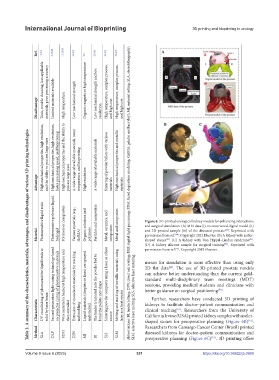
                   Photosensitive liquid resin  Photosensitive polymer liquid,   Polymers or composites  Various materials (e.g.,   Organic solutions and   Particles and composites  Metal, ceramics, and   Metal and composites  Figure 6. 3D-printed urological kidney models for enhancing interactions


                                                               and surgical simulation. (A) MRI data (i), reconstructed digital model (ii)
                 Material  hydrogel  GelMA)  polymers  composites  and 3D-printed sample (iii) of the diseased prostate . Reprinted with
                                                                                                 [48]
                                                               permission from ref. . Copyright 2021 Elsevier. (B) A kidney with antler-
                                                                            [48]
                                                                        [51]
                                                               shaped stones . (C) A kidney with Von Hippel–Lindau syndrome .
                                                                                                           [51]
                                                                                                 [51]
                                                               (D) A kidney silicone sample for surgical training . Reprinted with
                                                                            [51]
                                                               permission from ref. . Copyright 2019 Elsevier.
                   UV crosslinking of photosensitive liquid resin to  Second-generation light-curing technology based  on projector curing of photosensitive materials Wire material is heated at high temperature and  Extrusion of viscoelastic materials for stacking   Liquid materials (droplets or lines) are sprayed   The binder is injected into the powder bed to  Sintering powder compacts using a laser as a heat  Melting and stacking of metallic materials using   2D flat d
                                                               means  for  simulation is  more  effective than  using  only
                                                                         [49]
                                                               can achieve better understanding than the current gold-
                                                               standard multi-disciplinary team meetings (MDT)
                                                               sessions, providing medical students and clinicians with
                                                               better guidance on surgical positioning .
                                                                                              [50]
                                                                  Further, researchers have conducted 3D printing of
                 Characteristic  solid by laser beam  then extruded  and molding  and stacked.  bond the pellets into shape  source  laser as a heat source SLM, selective laser melting; SLS, selective laser sintering.  kidneys to facilitate doctor–patient communication and
                                                               clinical teaching . Researchers from the University of
                                                                            [51]
                                                               California Irvine (USA) printed kidney samples with antler-
                                                               shaped  stones  for preoperative  planning (Figure  6B) .
                                                                                                           [51]
                 Method  SLA  DLP  FDM  DIW  MJ  BJ  SLS  SLM  Researchers from Camargo Cancer Center (Brazil) printed
                                                               diseased kidneys for doctor–patient communication and
                                                               preoperative planning (Figure 6C) . 3D printing offers
                                                                                           [51]

            Volume 9 Issue 6 (2023)                        331                          https://doi.org/10.36922/ijb.0969

