


Page 343 - IJB-9-6
P. 343
International Journal of Bioprinting                                   3D printing and bioprinting in urology


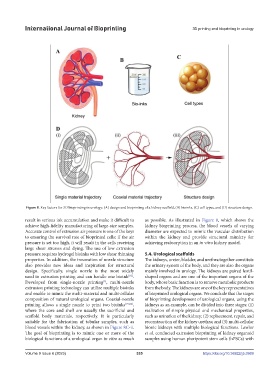
            Figure 8. Key factors for 3D bioprinting in urology: (A) design and bioprinting of a kidney scaffold, (B) bioinks, (C) cell types, and (D) structure design.


            result in serious ink accumulation and make it difficult to   as possible. As illustrated in  Figure 8, which shows the
            achieve high-fidelity manufacturing of large-size samples.   kidney  bioprinting  process,  the  blood  vessels  of  varying
            Accurate control of extrusion air pressure is one of the keys   diameter are expected to mimic the vascular distribution
            to ensuring the survival rate of bioprinted cells; if the air   within the kidney and provide structural mimicry for
            pressure is set too high, it will result in the cells receiving   achieving reabsorption in an in vitro kidney model.
            large shear stresses and dying. The use of low extrusion
            pressure requires hydrogel bioinks with low shear thinning   5.4. Urological scaffolds
            properties. In addition, the innovation of nozzle structure   The kidneys, ureter, bladder, and urethra together constitute
            also provides new ideas and inspiration for structural   the urinary system of the body, and they are also the organs
            design. Specifically, single nozzle is the most widely   mainly involved in urology. The kidneys are paired lentil-
            used in extrusion printing and can handle one bioink .   shaped organs and are one of the important organs of the
                                                        [81]
            Developed from  single-nozzle printing , multi-nozzle   body, whose basic function is to remove metabolic products
                                             [3]
            extrusion printing technology can utilize multiple bioinks   from the body. The kidneys are one of the key representatives
            and enable to mimic the multi-material and multi-cellular   of bioprinted urological organs. We conclude that the stages
            composition of natural urological organs. Coaxial-nozzle   of bioprinting development of urological organs, using the
            printing allows a single nozzle to print two bioinks [75,82] ,   kidneys as an example, can be divided into three stages: (1)
            where the core and shell are usually the sacrificial and   realization of simple physical and mechanical properties,
            scaffold body materials, respectively. It is particularly   such as urination of the kidney; (2) replacement, repair, and
            suitable for the fabrication of tubular samples, such as   reconstruction of the kidney urethra; and (3) multi-cellular
            blood vessels within the kidney, as shown in Figure 8C-ii.    bionic kidneys with multiple biological functions. Lawlor
            The  goal of  bioprinting  is to  mimic  one or  more of  the   et al. conducted extrusion bioprinting of kidney organoid
            biological functions of a urological organ in vitro as much   samples using human pluripotent stem cells (hPSCs) with


            Volume 9 Issue 6 (2023)                        335                          https://doi.org/10.36922/ijb.0969

